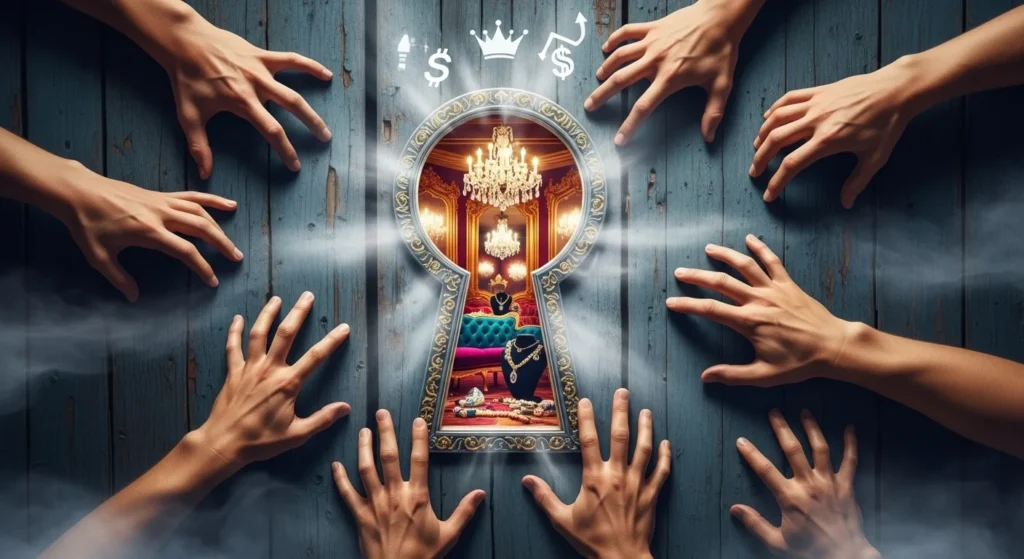
Why Desire Rarely Starts With Logic
You don’t wake up wanting everything.
You want specific things.
Often the ones just out of reach.
A watch with a waiting list.
A private club with no applications.
A product you almost bought—but couldn’t.
The strange part?
The desire usually grows stronger after denial, not weaker.
This isn’t a flaw in judgment.
It’s a deeply human response—wired into how the brain assigns value.
And in the world of luxury, this mechanism is intentionally activated.
The Scarcity Effect: Why “Limited” Feels Magnetic
When something is available to everyone, the brain relaxes.
When something is restricted, the brain leans forward.
- Heightened attention
- Emotional arousal
- Anticipation and imagination
Psychologists call this the scarcity effect—when limited access increases perceived value.
Luxury brands understand this intuitively.
That’s why:
- Waiting lists exist
- Supply is intentionally controlled
- Entry is unclear, not straightforward
Owning becomes less important than qualifying.
Desire Is Fueled by Distance, Not Ownership
Here’s the counterintuitive truth:
The moment something becomes fully accessible, its emotional charge drops.
Desire thrives on:
- Distance
- Delay
- Uncertainty
This is why browsing can feel more exciting than buying.
Why anticipation feels richer than possession.
Luxury works best before the purchase.
That space—between wanting and having—is where meaning forms.
Why Status Isn’t About Objects — It’s About Signals
People rarely desire objects in isolation.
They desire what those objects signal.
- Belonging to a select group
- Taste, not money
- Discernment, not consumption
When access is restricted, the signal strengthens.
A quietly scarce product says more than a loud, available one.
This is why brands like Hermès or Rolex don’t chase volume.
They protect distance.
The Psychological Loop That Keeps Desire Alive
Desire follows a predictable emotional cycle:
- Awareness – You notice what others can’t easily get
- Imagination – You project meaning onto it
- Friction – Access feels uncertain or delayed
- Validation – Scarcity confirms its importance
- Attachment – Desire deepens before ownership
Luxury brands don’t sell products.
They engineer this loop.
Why People Value What Excludes Them
Exclusion hurts—but it also elevates.
When something isn’t available to you:
- The brain assumes others were chosen
- Value becomes social, not functional
- Desire becomes personal
This is why:
- “Invite-only” outperforms “limited time”
- Private access beats public discounts
- Quiet luxury outlasts visible excess
Exclusivity isn’t arrogance.
It’s psychological positioning.
Comparison Table: Accessible vs Scarce Desire
| Factor | Easily Available | Hard to Access |
|---|---|---|
| Emotional Response | Neutral | Heightened |
| Perceived Value | Functional | Symbolic |
| Longevity of Desire | Short-term | Long-term |
| Social Signal | Common | Distinct |
| Satisfaction Curve | Quick drop | Slow, sustained |
Why This Matters Today (More Than Ever)
We live in a world of:
- Infinite choice
- Constant availability
- Instant gratification
As access increases, meaning decreases.
That’s why modern luxury is shifting:
- From loud logos to quiet signals
- From visibility to discretion
- From ownership to belonging
What’s hard to get now isn’t money.
It’s distinction.
Common Mistakes People Make About Desire
Many people misunderstand why they want what they want.
Here are the most common traps:
- Confusing desire with need
- Believing ownership will sustain emotion
- Chasing visibility instead of meaning
- Assuming more access equals more satisfaction
Desire fades when it’s misunderstood.
How to Use This Insight (Without Falling for It)
You don’t need to reject desire.
You need to read it correctly.
Actionable ways to apply this insight:
- Pause when something feels urgent
- Ask what the object symbolizes
- Notice if desire grew after resistance
- Separate emotional meaning from functional use
The smartest consumers aren’t immune to desire.
They’re aware of it.
Hidden Truth: Luxury Is a Psychological Agreement
Luxury only works when:
- Brands withhold access
- Consumers accept the rules
- Society respects the signal
Once any part collapses, value erodes.
This is why:
- Overexposed brands decline
- Mass luxury loses meaning
- Quiet brands gain power
Luxury survives by not being everywhere.
Key Takeaways
- People desire what they can’t have because scarcity amplifies meaning
- Distance fuels imagination more than possession
- Status is about signaling, not spending
- Desire peaks before ownership, not after
- True luxury protects access, not attention
Frequently Asked Questions
1. Is wanting what you can’t have a weakness?
No. It’s a natural psychological response tied to survival, status, and meaning.
2. Why does desire fade after purchase?
Because anticipation activates more emotion than ownership.
3. Do luxury brands intentionally create scarcity?
Yes—controlled access preserves perceived value and long-term relevance.
4. Can everyday items trigger the same effect?
Absolutely. Anything rare, selective, or delayed can activate desire.
5. How can consumers avoid regret-driven purchases?
By identifying whether they want the object or the symbol it represents.
Conclusion: Desire Isn’t About Having — It’s About Meaning
We don’t want everything.
We want what feels earned, rare, and symbolic.
The things we can’t have force us to imagine who we might become if we did.
That’s the real power of desire.
Not possession.
Not price.
But the story we attach to distance.
Disclaimer: This article explores psychological and cultural patterns for educational and lifestyle insight. Individual motivations and experiences may vary.
Pingback: Why Luxury Is About Belonging — The Emotional Currency That Truly Defines Status
Pingback: Inside the $50,000 Medical Memberships the Wealthy Pay For