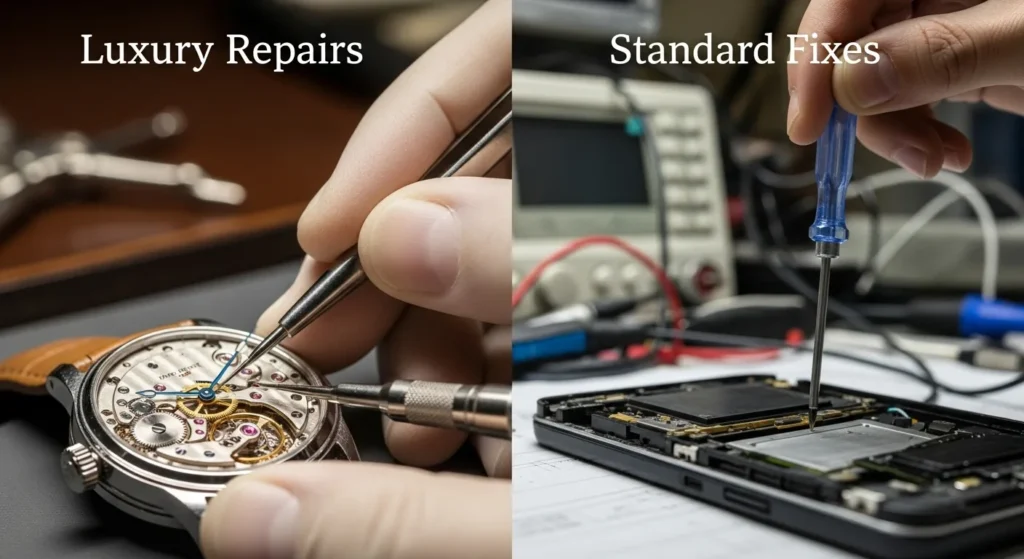
The Waiting That Feels Personal
You drop off a luxury item expecting professionalism.
You don’t expect weeks—or months—of waiting.
No updates.
No rushing.
No shortcuts.
At first, it feels frustrating. Then confusing. And eventually, personal.
But luxury repairs aren’t slow because brands don’t care. They’re slow because speed contradicts how luxury works.
Once you understand the system behind luxury repairs, the wait stops feeling like a problem—and starts making sense.
Luxury Repairs Aren’t Repairs—They’re Restorations
Standard products are repaired to function again.
Luxury products are repaired to original condition.
That difference changes everything.
Luxury repair means:
- Returning factory-level tolerances
- Preserving aesthetic perfection
- Protecting resale value
- Maintaining brand integrity
A watch from Rolex or Patek Philippe isn’t “fixed” until it meets the same standards as a new piece.
Precision replaces urgency.
Brand-Controlled Repair Pipelines Slow Everything Down
Luxury brands tightly control their repair ecosystem.
This includes:
- Authorized service centers only
- Restricted parts distribution
- Mandatory documentation
- Serial-number tracking
- Quality audits at multiple stages
Unlike mass-market repairs, there is no improvisation.
Every step requires approval.
Control protects brand value—but it slows the process by design.
Specialized Parts Aren’t Sitting on Shelves
Luxury components aren’t stocked like standard parts.
They are often:
- Made in limited production runs
- Produced only after diagnosis
- Tracked by serial number
- Released only to approved facilities
A replacement part for a vehicle from Ferrari may need to be manufactured, inspected, logged, and shipped internationally before work can even begin.
Waiting starts before repair does.
Skilled Hands Are Scarce—and Carefully Scheduled
Luxury repairs require specialists, not general technicians.
Think:
- Master watchmakers
- Certified performance engineers
- Leather restoration artisans
- Finishing and polishing experts
These professionals:
- Handle limited items per day
- Work in controlled conditions
- Follow multi-step verification
Their workload is capped to avoid errors.
Speed increases mistakes.
Mistakes destroy value.
Luxury chooses patience.
Inspection Takes Longer Than the Repair Itself
One of the least visible delays is diagnostics.
Luxury brands don’t assume the obvious problem is the only problem.
They inspect:
- Adjacent components
- Wear patterns
- Structural alignment
- Cosmetic consistency
This prevents future failures—but adds days or weeks.
The repair you notice may be minor.
The inspection you don’t see is extensive.
Comparison Table: Standard vs. Luxury Repair Timelines
| Factor | Standard Repair | Luxury Repair |
|---|---|---|
| Goal | Restore function | Restore original condition |
| Parts Access | Immediate | Restricted |
| Labor | General technicians | Certified specialists |
| Approval Layers | Minimal | Multiple |
| Timeline | Days | Weeks to months |
Why Quality Control Adds More Waiting
Luxury brands inspect repaired items multiple times.
Common quality steps include:
- Pre-repair assessment
- Mid-process verification
- Post-repair inspection
- Final cosmetic review
If something is slightly off—even if functional—the process restarts.
This isn’t inefficiency.
It’s intolerance for imperfection.
The Resale Value Factor Most Owners Miss
Luxury repairs are slow because they protect future value.
A poorly documented or rushed repair can:
- Reduce resale value
- Disqualify certification programs
- Trigger buyer distrust
A handbag from Hermès, for example, holds value only when restoration preserves original materials, stitching, and finish.
The repair timeline safeguards liquidity.
The Time Cost Is Part of the Luxury Signal
Luxury operates outside urgency.
Speed implies replaceability.
Slowness implies permanence.
By refusing to rush, luxury brands signal:
- Rarity
- Care
- Precision
- Longevity
Waiting isn’t a flaw in the system.
It is the system.
Common Mistakes That Make Luxury Repairs Take Even Longer
Owners unintentionally add delays by:
- Using unauthorized repair shops
- Skipping documentation
- Attempting DIY fixes
- Delaying service until damage spreads
- Modifying items before repair
These force brands to undo prior work—or reject items entirely.
Shortcuts create long waits.
Hidden Tip: Early Intervention Saves Weeks
Luxury repairs move fastest when issues are caught early.
Owners who:
- Address problems immediately
- Follow service schedules
- Avoid temporary fixes
- Store items correctly
experience shorter repair timelines and lower costs.
Waiting to “see if it gets worse” almost always backfires.
Why This Matters Today
Luxury ownership is expanding beyond traditional elites.
More first-time buyers are entering systems built for patience—not convenience.
When expectations don’t match reality, frustration grows.
Understanding repair timelines:
- Reduces anxiety
- Prevents unnecessary escalation
- Protects long-term value
Informed ownership is the new status signal.
Actionable Steps Before Sending Anything for Luxury Repair
Before handing over a luxury item:
- Ask for expected timelines, not best-case estimates
- Confirm authorization and documentation requirements
- Avoid third-party fixes beforehand
- Prepare for international shipping delays
- Plan alternatives—you may not see the item for months
Preparation removes resentment.
Emotional Reality: Waiting Feels Worse Than Cost
Many owners tolerate high prices—but struggle with waiting.
Why?
Because time feels personal.
Luxury repairs challenge modern expectations of immediacy. But once you accept that luxury moves at a different pace, frustration softens.
The wait isn’t neglect.
It’s protection.
Key Takeaways
- Luxury repairs take longer by design, not inefficiency
- Brand control and precision slow timelines
- Parts scarcity and specialist labor add delays
- Inspections and quality checks outweigh repair time
- Waiting protects resale value and brand integrity
Frequently Asked Questions (FAQ)
1. Why can’t luxury repairs be rushed for a fee?
Because rushing increases risk and undermines brand standards.
2. Is my item just sitting somewhere untouched?
Usually no. Most delays involve inspection, approvals, or parts logistics.
3. Do all luxury brands take this long?
Timelines vary, but controlled brands consistently prioritize precision over speed.
4. Can unauthorized repairs permanently affect value?
Yes. They can reduce resale value and complicate future servicing.
5. Is waiting unavoidable with luxury ownership?
Yes. Time is part of the ownership contract.
Conclusion: Time Is the Price of Precision
Luxury repairs aren’t slow because brands don’t value your time.
They’re slow because they value what the item represents.
Precision over speed.
Permanence over convenience.
Integrity over urgency.
Once you understand that, the wait stops feeling like a problem—and starts feeling like part of the promise.
Disclaimer: This article is for general informational purposes and reflects common luxury industry practices. Repair timelines and experiences may vary by brand and item.
Pingback: Why Insurance Costs Rise With Luxury: The Risk Equation Most Owners Never See