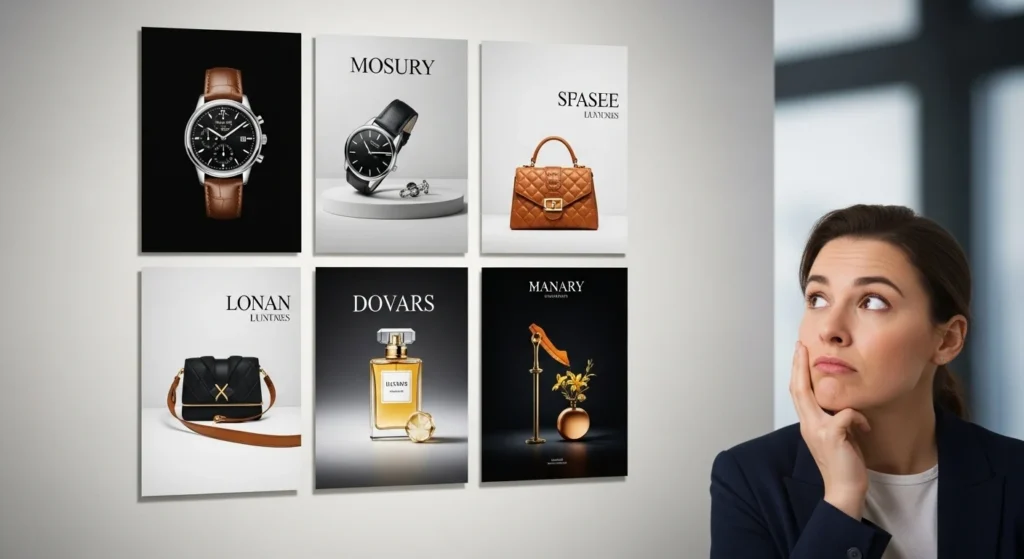
The Most Powerful Message Is Often Unspoken
Think about the last luxury advertisement you saw.
It probably didn’t explain:
- What the product does
- Why it’s better
- How it compares
- What problem it solves
And yet—it lingered.
Luxury marketing often feels mysterious, emotional, and oddly silent.
That silence is not accidental.
Luxury brands avoid explanation because explanation changes how the brain values something. And once you understand that, luxury marketing starts to make perfect sense.
Explanation Belongs to Utility. Luxury Belongs to Meaning.
Explanation is useful.
It clarifies.
It educates.
It reduces uncertainty.
That’s exactly why mass-market brands rely on it.
Luxury, however, operates in a different psychological space.
Luxury is not about:
- Solving problems
- Maximizing efficiency
- Justifying price
It’s about signaling identity, taste, and belonging.
And identity loses power when it’s explained too clearly.
Why Explaining Too Much Lowers Perceived Value
When a brand explains itself in detail, it sends an unconscious signal:
“You need convincing.”
Luxury brands avoid explanation because the need to explain suggests doubt.
High-status signals work differently:
- They assume understanding
- They imply shared knowledge
- They reward those who “get it”
In luxury, clarity can feel like desperation.
Ambiguity, on the other hand, feels confident.
The Psychology Behind “If You Know, You Know”
Luxury marketing often operates on a quiet code.
It doesn’t shout.
It doesn’t justify.
It doesn’t persuade.
Instead, it whispers.
This creates a powerful psychological filter:
- Those who understand feel included
- Those who don’t feel curious
- No one feels chased
Luxury avoids explanation because interpretation creates ownership.
When people decode meaning themselves, emotional attachment deepens.
Silence as a Signal of Authority
In human interaction, the most powerful person in the room is often the one who speaks least.
Luxury brands borrow this exact dynamic.
By avoiding explanation, they signal:
- Confidence
- Authority
- Cultural leadership
They don’t ask for attention.
They assume it.
That assumption is what makes luxury feel elevated.
Real-World Examples of Luxury Avoiding Explanation
Chanel
Chanel ads rarely explain:
- Fabric quality
- Production process
- Price logic
Instead, they show mood, movement, and attitude.
The message isn’t “buy this.”
It’s “this world exists—enter if you belong.”
Hermès
Hermès almost never explains why its products cost what they do.
There’s no breakdown.
No persuasion.
No justification.
The brand assumes that craftsmanship speaks for itself—and silence reinforces confidence.
Rolex
Rolex doesn’t aggressively explain technical superiority in mass ads.
Instead, it associates itself with:
- Achievement
- Milestones
- Legacy
The product becomes a symbol, not a spec sheet.
Explanation Turns Desire Into Evaluation
Here’s a crucial distinction.
When something is explained, the brain switches modes:
- From emotional to analytical
- From desire to evaluation
- From aspiration to comparison
Luxury brands avoid explanation because comparison is dangerous.
Once consumers compare:
- They question pricing
- They look for alternatives
- They seek justification
Luxury thrives when comparison never starts.
Why Mystery Increases Memorability
Cognitive science shows that incomplete information is more memorable than complete information.
This is known as the “curiosity gap.”
Luxury marketing leverages this by:
- Showing fragments
- Suggesting stories
- Leaving gaps
When the brain fills in the blanks, engagement increases.
Explanation closes the loop too quickly.
Mass Marketing vs Luxury Marketing Communication
| Aspect | Mass Marketing | Luxury Marketing |
|---|---|---|
| Communication Style | Explicit | Implicit |
| Focus | Features & benefits | Emotion & identity |
| Tone | Persuasive | Assumptive |
| Goal | Convince | Attract |
| Role of Explanation | Central | Avoided |
Luxury doesn’t sell answers.
It invites interpretation.
Why This Matters Today More Than Ever
We live in an age of:
- Constant explanations
- Endless tutorials
- Over-clarity
- Algorithmic persuasion
In this environment, silence stands out.
Luxury brands that avoid explanation feel:
- Calm
- Confident
- Timeless
They don’t compete in the attention economy.
They exist above it.
The Hidden Risk of Over-Explaining Luxury
Brands that explain too much often face:
- Brand dilution
- Price resistance
- Short-term gains, long-term loss
Over-explaining trains consumers to ask:
“Is it worth it?”
Luxury wants consumers to feel:
“Of course it is.”
That emotional certainty disappears with too much logic.
Common Mistakes Brands Make When Imitating Luxury
Many brands misunderstand luxury silence.
They:
- Remove explanation without building meaning
- Copy aesthetics without authority
- Go quiet without confidence
Silence only works when backed by:
- Craft
- Consistency
- Cultural relevance
Luxury earns the right to say less.
Actionable Lessons for Brands and Creators
You don’t need to be a luxury brand to apply this.
You can:
- Reduce over-explaining in messaging
- Let visuals do more work
- Trust your audience’s intelligence
- Replace persuasion with presence
- Design moments of interpretation
Sometimes, clarity isn’t persuasive—confidence is.
Why Luxury Marketing Chooses Emotion Over Education
Education answers questions.
Emotion creates meaning.
Luxury avoids explanation because meaning lasts longer than information.
People forget facts.
They remember feelings.
And luxury brands are built on remembered feelings.
Key Takeaways
- Luxury marketing avoids explanation to preserve desire and authority
- Silence signals confidence and status
- Explanation invites comparison and doubt
- Mystery increases emotional engagement
- Less information can create more value
Frequently Asked Questions (FAQ)
1. Is avoiding explanation manipulative?
No. It’s a positioning choice that respects emotional decision-making.
2. Do luxury brands ever explain anything?
Yes—but selectively, usually in private or experiential settings.
3. Can non-luxury brands use this strategy?
Yes, but only when paired with strong brand foundations.
4. Why does explanation reduce luxury appeal?
Because it shifts focus from identity to evaluation.
5. Is silence risky in marketing?
Only if the brand lacks credibility or meaning.
Conclusion: Silence Is Not Absence—It’s Power
Luxury marketing doesn’t avoid explanation because it has nothing to say.
It avoids explanation because saying less says more.
In a world addicted to clarity, luxury chooses confidence.
In a market full of persuasion, luxury chooses presence.
And that quiet confidence is exactly what makes it powerful.
Disclaimer: This article is for general educational and informational purposes and reflects branding and communication insights, not commercial or financial advice.
Pingback: Why Luxury Beauty Uses Fewer Claims — The Quiet Strategy That Builds Trust, Desire, and Long-Term Loyalty
Pingback: Why Luxury Beauty Avoids Explanation — The Silent Strategy That Builds Desire, Trust, and Power
Pingback: Why Luxury Brands Avoid Influencers (And What They Protect by Staying Silent)
Pingback: Why Luxury Advertising Feels Emotional (And Why Logic Is Never the Point)
Pingback: Why Luxury Brands Care About Store Design — The Silent Sales Tool That Shapes Desire
Pingback: Why Some Luxury Brands Feel Powerful Without Advertising — The Quiet Strategy That Builds Desire Automatically