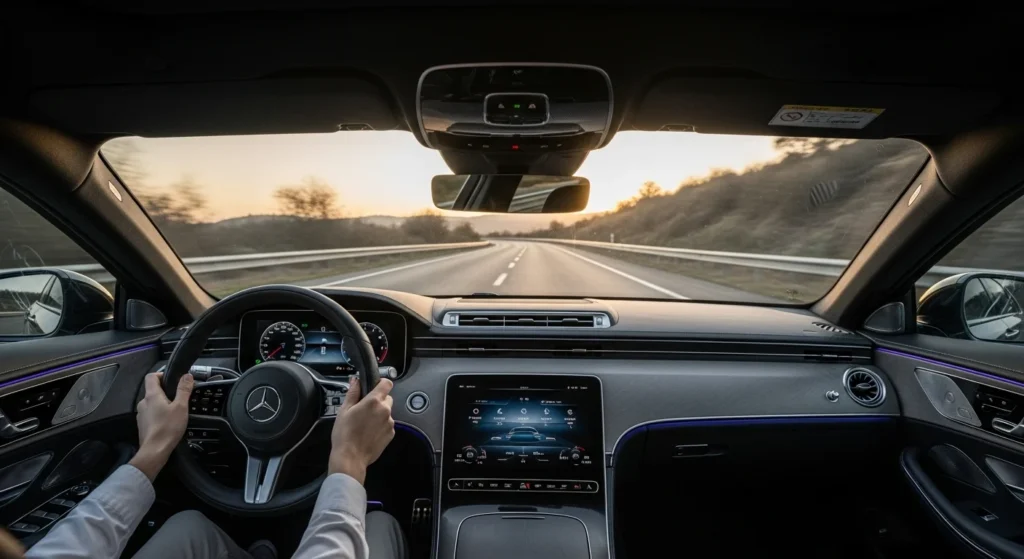
The Moment You Stop Correcting
You’re driving on an uneven road.
There’s wind.
Traffic shifts.
The surface changes.
And yet—you’re not correcting constantly.
Your hands are relaxed.
Your shoulders are loose.
The car just… holds its line.
Luxury cars have a way of making complexity disappear. Not by overwhelming the driver with feedback—but by managing chaos quietly, in the background.
That feeling isn’t luck.
It’s deliberate design.
Control Isn’t Tightness — It’s Predictability
Many people confuse control with stiffness.
But stiffness alone doesn’t create confidence. It creates tension.
True control means:
- Predictable reactions
- Consistent behavior
- Minimal surprises
Luxury cars are tuned to behave the same way whether:
- You’re cruising calmly
- Changing lanes
- Braking unexpectedly
That consistency is what allows your brain to trust the car.
And trust changes everything.
The Core Luxury Principle: Fewer Corrections, Less Effort
Luxury car engineering starts with a human-centered question:
“How can we reduce how often the driver needs to intervene?”
That goal influences:
- Steering calibration
- Suspension geometry
- Throttle mapping
- Brake modulation
- Electronic assistance systems
Instead of sharpening reactions, luxury cars smooth them.
Brands like Mercedes-Benz and Lexus design cars so the driver feels supported, not challenged.
Chassis Balance: Where Control Begins
Before electronics, before tuning, control starts with balance.
Luxury cars prioritize:
- Even weight distribution
- Low center of gravity
- Wide, stable track
This reduces:
- Sudden weight transfer
- Body roll
- Mid-corner instability
When mass is managed well, the car doesn’t fight physics.
It works with it.
That’s why luxury cars often feel composed even when they’re large or heavy.
Suspension Tuning: Movement That Ends Quickly
Luxury suspension doesn’t try to eliminate movement.
It tries to end it gracefully.
Instead of bouncing or snapping back, luxury suspension:
- Absorbs impact gradually
- Controls rebound precisely
- Settles the body quickly
Adaptive systems—common in vehicles from BMW and Audi—adjust in real time to road conditions.
The result?
- Less steering correction
- Less passenger movement
- More confidence at speed
Control is felt most in what doesn’t happen.
Steering Calibration: The Language of Control
Steering is how a car “talks” to you.
Luxury steering speaks calmly.
It’s tuned to:
- Resist overreaction
- Provide progressive feedback
- Stay stable at higher speeds
This prevents:
- Nervous lane wandering
- Overcorrection
- Driver fatigue
The wheel doesn’t demand attention.
It reassures.
That quiet communication is central to the feeling of control.
Braking Systems: Confidence Without Drama
Aggressive brakes grab hard.
Luxury brakes modulate.
They are designed to:
- Respond smoothly to light pressure
- Build force predictably
- Avoid sudden nose dive
This allows:
- Better passenger comfort
- More accurate stopping
- Less panic under stress
Controlled braking keeps the cabin calm—even during urgent situations.
Electronic Systems: Control You Rarely Notice
Luxury cars rely heavily on electronics—but the best ones stay invisible.
These systems:
- Monitor steering angle
- Track wheel speed
- Predict traction loss
When intervention is needed, it happens:
- Early
- Gently
- Seamlessly
Unlike abrupt corrections in cheaper cars, luxury systems preserve natural driving feel.
You remain in control—even when the car is quietly helping.
Noise Control: Calm Senses, Better Control
Noise interferes with perception.
Luxury cars minimize it aggressively through:
- Acoustic glass
- Structural insulation
- Isolated subframes
Less noise means:
- Better focus
- Clearer feedback
- Reduced mental load
When your senses aren’t overloaded, your inputs become smoother.
Control improves because the environment is calmer.
Luxury Cars vs Ordinary Cars: Control Compared
| Aspect | Luxury Cars | Mass-Market Cars |
|---|---|---|
| Steering | Progressive, stable | Light, reactive |
| Suspension | Settling, adaptive | Reactive, basic |
| Brakes | Smooth, predictable | Grabby |
| Noise Levels | Low | Higher |
| Driver Effort | Minimal | Frequent |
Luxury doesn’t overpower the driver.
It reduces the need for effort.
Why This Matters Today
Modern driving is complex.
Traffic density.
Distractions.
Unpredictable conditions.
Control isn’t about speed anymore.
It’s about:
- Reducing fatigue
- Preventing mistakes
- Preserving attention
Luxury cars are engineered for the real world—not the racetrack.
They help drivers stay composed when the environment isn’t.
Common Mistakes Buyers Make
Many buyers misunderstand control because they:
- Test-drive only at low speeds
- Confuse excitement with precision
- Expect sharpness instead of stability
True control often feels subtle.
It becomes obvious when conditions worsen.
Hidden Tip: How to Feel Control During a Test Drive
When evaluating a luxury car:
- Drive on uneven roads
- Make gentle steering inputs
- Brake smoothly, then firmly
- Notice how little correction you need
The more relaxed you feel, the more controlled the car is.
Actionable Steps for Buyers
If control matters to you:
- Look for adaptive suspension
- Pay attention to steering weight
- Test braking smoothness
- Drive at highway speeds
- Focus on fatigue, not thrill
Control is about long-term comfort, not instant excitement.
Key Takeaways
- Luxury cars feel controlled by reducing unpredictability
- Balance and tuning matter more than raw stiffness
- Smooth systems lower driver effort
- Quiet improves perception and confidence
- True control reveals itself over time
Frequently Asked Questions
1. Does controlled driving mean less performance?
No. It means performance delivered predictably.
2. Why do luxury cars feel easier to drive?
Because they require fewer corrections and less effort.
3. Is control more important than speed?
For daily driving, absolutely.
4. Do electronics reduce driver involvement?
In luxury cars, they enhance confidence without intrusion.
5. Can smaller luxury cars feel just as controlled?
Yes—control comes from tuning, not size.
Conclusion: Control Is Confidence You Can Feel
Luxury cars don’t rush you.
They don’t challenge you.
They support you—quietly, consistently, and confidently.
That feeling of control isn’t about domination.
It’s about trust.
And once you experience it, driving anything else starts to feel unnecessarily demanding.
Disclaimer: This article is for general informational purposes only and reflects broad automotive design principles rather than specific vehicle recommendations.
Pingback: Why Luxury Cars Avoid Aggression — The Quiet Design Choice That Signals Real Power
Pingback: Why Luxury Cars Prioritize Smoothness — The Hidden Engineering That Makes Them Feel Effortless
Pingback: Why Luxury Cars Feel Stable — The Invisible Engineering That Makes You Trust Them Instantly