The First Few Seconds Tell You Everything
You sit down.
The door closes with a soft, confident thump.
The outside world fades—not dramatically, just enough.
Before the engine starts, your body already relaxes.
Luxury cars don’t announce calm.
They engineer it invisibly.
That calm feeling isn’t about leather seats or glossy dashboards.
It’s the result of hundreds of micro-decisions—acoustic, mechanical, psychological—working together to lower your stress without you realizing it.
This article breaks down why luxury cars feel calm, how they quietly rewire your driving experience, and what most people misunderstand about premium comfort.
Calm Is Designed Long Before the Car Is Built
Luxury brands don’t start with horsepower targets.
They start with human sensation.
Engineers at brands like Mercedes-Benz and BMW measure:
- Heart rate changes
- Muscle tension
- Brain response to vibration and sound
- Driver fatigue after long drives
Calm is treated as a performance metric.
That means:
- Fewer sharp sensations
- Fewer unpredictable inputs
- More consistency in motion, sound, and feedback
Luxury cars aim to remove friction—both mechanical and mental.
Silence Isn’t the Absence of Sound — It’s the Right Sound
Most people assume luxury cars are calm because they’re “quiet.”
That’s only half true.
Luxury cars are selectively quiet.
They eliminate:
- High-frequency road noise (which stresses the brain)
- Harsh engine vibrations
- Wind turbulence around mirrors and pillars
But they preserve:
- Low, steady engine tones
- Gentle airflow sounds
- Soft suspension movement cues
This is why a Rolls-Royce Phantom cabin feels cocooned rather than sterile.
Total silence feels unnatural.
Controlled sound feels reassuring.
The Suspension Does Emotional Work Too
Luxury suspension systems don’t just smooth bumps.
They predict discomfort.
Modern premium vehicles use:
- Adaptive dampers
- Road-scanning cameras
- AI-controlled suspension responses
A system like Magic Body Control adjusts the car before your body feels the road.
Your brain loves predictability.
When motion feels controlled:
- Muscles relax
- Jaw tension drops
- Fatigue slows down
This is why long drives in luxury cars feel shorter—even when traffic is bad.
Steering That Reassures, Not Demands
In many mass-market cars:
- Steering is either too light (nervous)
- Or too heavy (fatiguing)
Luxury steering is tuned for confidence, not excitement.
It communicates just enough:
- Road texture without shock
- Direction changes without effort
- Stability without stiffness
Brands like Lexus spend years tuning steering feel to reduce subconscious correction.
Less correction = less mental load.
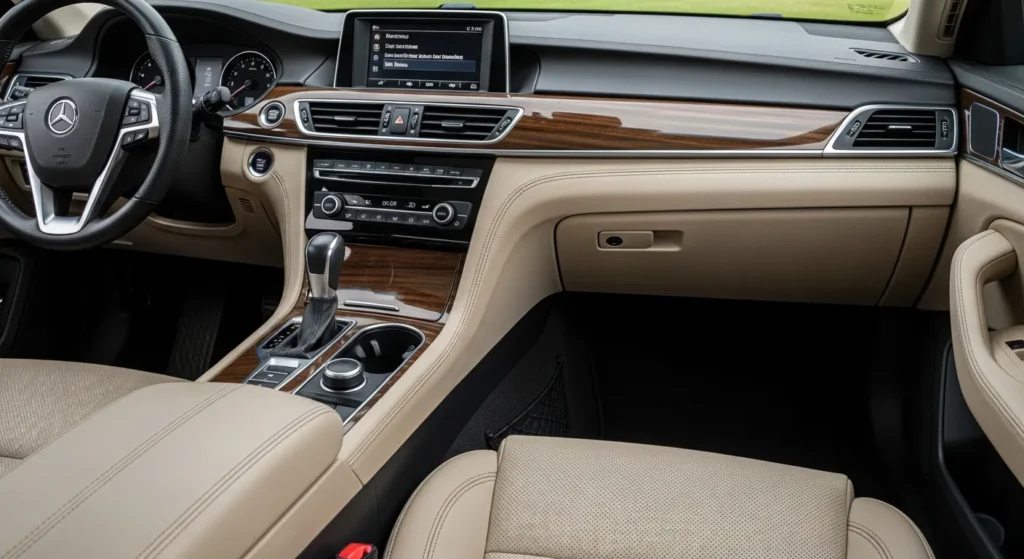
Why Interiors Feel Calm Even When They Look Simple
Luxury interiors often appear minimalist—but they’re anything but simple.
Every surface is engineered to:
- Avoid glare
- Reduce sharp visual contrast
- Feel warm to the touch
- Maintain consistent texture
Buttons resist your finger just enough.
Screens respond without lag.
Ambient lighting avoids blue-heavy tones that overstimulate the brain.
This is intentional neurological design.
The cabin becomes a low-stimulation environment—something rare in modern life.
Comparison: Luxury vs Standard Cars (Calm Factor)
| Feature | Standard Car | Luxury Car |
|---|---|---|
| Cabin Noise Control | Basic insulation | Multi-layer acoustic glass |
| Suspension | Reactive | Predictive + adaptive |
| Steering Feedback | Inconsistent | Tuned for reassurance |
| Interior Materials | Cost-optimized | Sensory-optimized |
| Driver Fatigue | High on long trips | Significantly reduced |
Luxury isn’t louder performance.
It’s quieter control.
Calm Comes From Removing Decision Fatigue
Luxury cars reduce the number of things you need to think about.
Examples:
- Automatic seat memory eliminates adjustment
- Head-up displays reduce eye movement
- Smooth gear shifts avoid decision interruptions
- Climate systems adjust subtly without alerts
The fewer micro-decisions you make, the calmer you feel.
This is why luxury cars feel mentally “lighter” to drive.
Real-Life Example: Why Long Drives Feel Easier
Drivers who switch from mid-range cars to premium sedans often report:
- Less shoulder pain
- Fewer headaches
- Lower exhaustion after travel
- Reduced road rage
This isn’t placebo.
Automotive fatigue studies show vibration, noise, and visual strain directly increase stress hormones.
Luxury cars reduce all three.
Common Mistakes People Make When Judging Luxury
❌ Focusing only on horsepower
❌ Equating comfort with softness
❌ Assuming calm means boring
❌ Ignoring long-term fatigue effects
True luxury isn’t exciting at first glance.
It’s relieving over time.
Hidden Tip: Test Drive Calm, Not Speed
When test-driving a luxury car:
- Drive in traffic, not highways
- Listen during idle
- Notice how often you adjust your posture
- Observe how your breathing changes
Calm reveals itself in what you stop noticing.
Why This Matters Today
Modern life is noisy, rushed, and overstimulating.
Luxury cars act as:
- A buffer between chaos and calm
- A private decompression space
- A mobile environment designed for mental ease
That emotional value now matters more than raw performance numbers.
Key Takeaways
- Luxury cars feel calm because they’re engineered for the human nervous system
- Silence is tuned, not absolute
- Predictive suspension reduces mental stress
- Interiors minimize sensory overload
- Calm is the ultimate premium feature
Frequently Asked Questions
1. Are luxury cars actually safer because they feel calm?
Yes. Reduced fatigue and better focus improve real-world safety outcomes.
2. Do electric luxury cars feel even calmer?
Often yes, due to reduced vibration and noise, but tuning still matters.
3. Is calmness the same as softness?
No. Calm comes from control, not softness.
4. Can aftermarket upgrades replicate this calm?
Partially, but factory integration is difficult to match.
5. Are luxury SUVs as calm as sedans?
High-end SUVs can be, but sedans still offer lower vibration profiles.
Conclusion
Luxury cars don’t shout their value.
They whisper it—to your nervous system, your muscles, your mind.
Calm isn’t an accident.
It’s the most expensive feature you never see.
And once you experience it, everything else feels unnecessarily loud.
Disclaimer: This article is for general informational purposes and reflects design principles and industry insights, not individual purchasing advice.
Pingback: Why Luxury Cars Focus on Comfort — The Real Reason Premium Driving Feels Effortless
Pingback: Why Silence Defines Luxury Cars — The Most Expensive Feature You Never See
Pingback: Why Luxury Cars Feel Controlled — The Invisible Mastery That Makes Driving Effortless
Pingback: Why Luxury Cars Feel Heavy — The Engineering Choice That Signals Power, Safety, and Control
Pingback: Why Luxury Cars Emphasize Quiet — The Hidden Power of Silence in Premium Driving