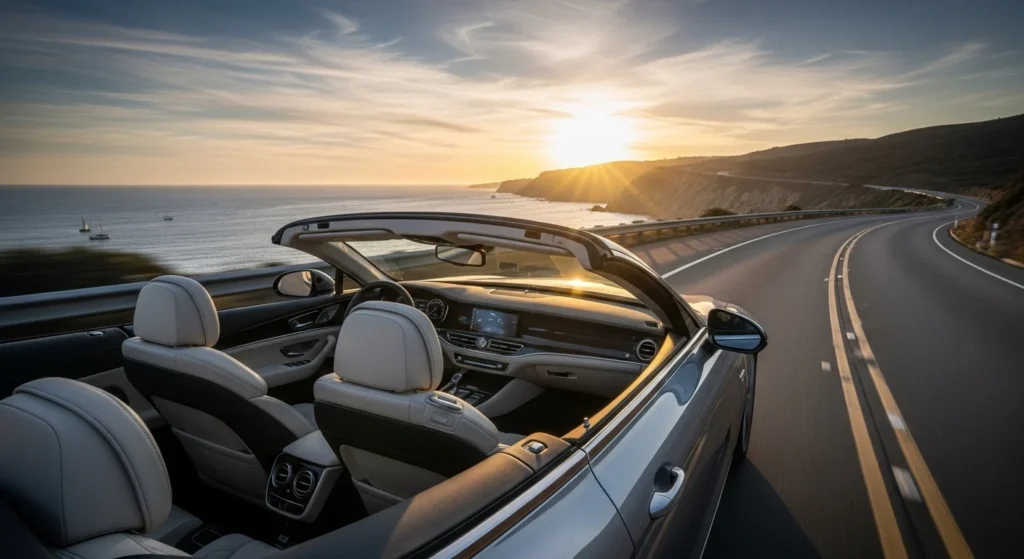
The Drive That Ends Too Soon
You step out after a three-hour drive.
No stiffness.
No mental exhaustion.
No urge to stretch immediately.
That’s when it hits you.
The drive didn’t take anything from you.
Luxury cars are not designed to impress in the first ten minutes. They are designed to protect you in the third hour—when most cars begin to feel tiring, noisy, and demanding.
And that difference defines what luxury really is.
Short Drives Lie — Long Drives Tell the Truth
Almost any car can feel fine for 15 minutes.
Even budget cars feel acceptable:
- On smooth roads
- At low speeds
- With fresh attention
Long drives are different.
They expose:
- Poor ergonomics
- Noisy cabins
- Overly stiff suspensions
- Inconsistent controls
Luxury cars are engineered with long-distance reality in mind—not ideal conditions.
The Core Luxury Question: How Long Can You Stay Comfortable?
Luxury car engineering often begins with one question:
“How can we reduce fatigue hour after hour?”
That question reshapes everything:
- Seat design
- Steering effort
- Suspension tuning
- Noise control
- Climate management
Brands like Mercedes-Benz and Lexus test vehicles on long highways, uneven roads, and real-world traffic—not just test tracks.
Luxury isn’t about peak moments.
It’s about endurance.
Seat Engineering: Comfort That Evolves With Time
Luxury seats aren’t just softer.
They’re smarter.
They use:
- Multi-density foam layers
- Extended thigh support
- Precise lumbar geometry
- Micro-adjustments for posture
Over long drives, these features:
- Reduce pressure points
- Support blood circulation
- Prevent lower-back strain
In cheaper cars, seats feel fine initially—then become uncomfortable.
Luxury seats improve as your body settles in.
Suspension Tuning: Absorbing the Road, Not You
Long drives magnify suspension flaws.
Luxury suspension is tuned to:
- Absorb imperfections gradually
- Prevent constant body correction
- Settle quickly after disturbances
Adaptive and air suspension systems—common in vehicles from BMW and Audi—adjust continuously to road conditions.
Instead of reacting sharply, luxury suspension negotiates with the road.
That negotiation saves your energy.
Steering and Controls: Less Effort, Less Fatigue
On long drives, small efforts add up.
Luxury steering is designed to:
- Stay light but stable
- Require fewer corrections
- Remain predictable at speed
Pedals, switches, and stalks are also tuned for:
- Consistent resistance
- Logical placement
- Muscle-memory use
The goal isn’t excitement.
It’s reducing micro-stress—the tiny efforts that drain you over hours.
Noise Control: Why Silence Matters More After Hour Two
Even if you don’t notice it consciously.
Luxury cars invest heavily in:
- Acoustic glass
- Dense insulation
- Isolated suspension mounts
- Engine vibration control
Less noise means:
- Lower mental load
- Slower perceived speed
- Better concentration
That’s why luxury cars feel calmer at highway speeds—where long drives actually happen.
Climate Control: Comfort Without Awareness
Luxury climate systems are designed to disappear.
They:
- Adjust gradually
- Maintain even temperatures
- Avoid harsh airflow
This prevents:
- Dry eyes
- Muscle stiffness
- Thermal fatigue
You shouldn’t feel the system working.
You should feel normal—even after hours.
Power Delivery: Smoothness Beats Drama
Aggressive acceleration is tiring.
Luxury engines are tuned for:
- Early torque
- Linear response
- Minimal vibration
This allows:
- Effortless overtaking
- Relaxed cruising
- Reduced tension
In luxury cars, speed feels optional—not demanding.
That’s ideal for long-distance driving.
Long Drive Comparison: Luxury vs Ordinary Cars
| Aspect | Luxury Cars | Mass-Market Cars |
|---|---|---|
| Seat Comfort | Improves over time | Declines |
| Cabin Noise | Remains low | Increases |
| Suspension | Settling, adaptive | Fatiguing |
| Steering Effort | Minimal | Demanding |
| Post-Drive Fatigue | Low | Higher |
Luxury isn’t about arriving fast.
It’s about arriving well.
Why This Matters Today
Modern driving involves:
- Long commutes
- Highway travel
- Multi-hour trips
Fatigue isn’t just uncomfortable—it affects:
- Focus
- Reaction time
- Decision-making
Luxury cars are designed to preserve mental and physical energy.
That’s not indulgence.
It’s practicality at a higher standard.
Common Mistakes Buyers Make
Many buyers misjudge long-drive comfort because they:
- Test-drive too briefly
- Focus on screens instead of seats
- Ignore highway testing
A car that excites you quickly may exhaust you slowly.
Luxury reveals itself only with time.
Hidden Tip: How to Test Long-Drive Readiness
When test-driving:
- Drive at highway speeds
- Sit for at least 30 minutes
- Turn off music briefly
- Notice posture, breathing, and tension
If you forget about the car, it’s doing its job.
Actionable Steps for Buyers
If long drives matter to you:
- Prioritize seat comfort over features
- Test suspension on rough roads
- Listen for cabin noise at speed
- Avoid oversized wheels
- Choose calm over excitement
Luxury should support your life—not drain it.
Key Takeaways
- Luxury cars are engineered for long-distance comfort
- Seats, suspension, and silence reduce fatigue
- Smooth controls lower mental effort
- Long drives reveal true quality
- Luxury protects energy, not ego
Frequently Asked Questions
1. Are luxury cars better for road trips?
Yes. They’re specifically engineered to reduce fatigue over long distances.
2. Why do luxury cars feel better after hours of driving?
Because comfort systems are designed to work over time, not instantly.
3. Is long-drive comfort more important than performance?
For most real-world driving, absolutely.
4. Do luxury cars help reduce driver fatigue?
Yes, through ergonomics, noise control, and predictable behavior.
5. Can smaller luxury cars also be good for long drives?
Yes—if comfort and tuning are prioritized.
Conclusion: Luxury Is How You Feel at the End
Anyone can build a car that feels good briefly.
Luxury cars are built for what comes after.
After the traffic.
After the miles.
After the excitement fades.
They protect your energy so the journey doesn’t cost you.
That’s why luxury cars aren’t designed for short drives.
They’re designed for the long ones that matter most.
Disclaimer: This article is for general informational purposes only and reflects broad automotive design principles rather than specific vehicle recommendations.
Pingback: Why Luxury Cars Avoid Aggression — The Quiet Design Choice That Signals Real Power