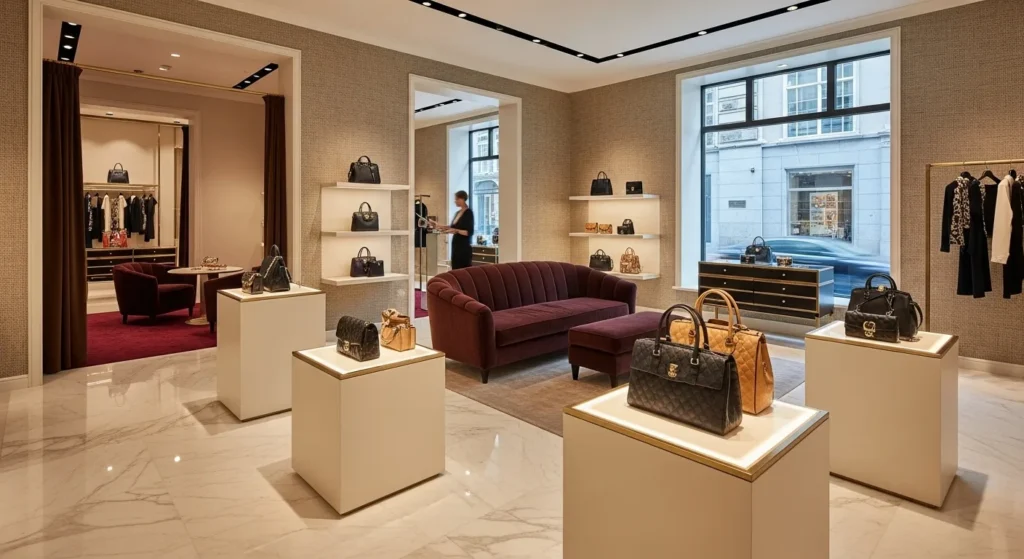
Luxury Stores Don’t Just Sell—They Speak
Walk into a luxury store, and something shifts.
The noise drops.
Your pace slows.
Your attention sharpens.
Nothing has been said—yet a message is already delivered.
Luxury brands don’t treat store design as decoration.
They treat it as communication.
Every material, layout, light source, and empty space is engineered to shape how you feel before you ever touch a product.
That’s why store design isn’t an expense in luxury—it’s strategy.
Why Store Design Matters More in Luxury Than in Any Other Category
Mass retail prioritizes efficiency.
Luxury prioritizes experience.
Luxury brands know that people don’t buy high-end products purely for function. They buy them for meaning, reassurance, and emotional alignment.
Store design helps deliver that instantly.
A well-designed luxury store communicates:
- Credibility
- Confidence
- Timelessness
- Control
- Taste
All without a single word spoken.
That silent communication is incredibly persuasive.
The Psychology: How Physical Space Shapes Perception
Human brains constantly interpret environments.
We subconsciously ask:
- Is this safe?
- Is this refined?
- Do I belong here?
Luxury stores are designed to answer yes to all three.
Research in environmental psychology shows that spacious layouts, natural materials, controlled lighting, and reduced clutter increase perceived value and trust.
That’s why luxury stores feel calm rather than busy.
Calm signals control.
Control signals power.
Why Luxury Stores Rarely Feel “Convenient”
One thing luxury stores intentionally avoid is speed.
You won’t find:
- Overcrowded shelves
- Loud promotions
- Directional arrows screaming urgency
Instead, you’ll find:
- Space to pause
- Objects displayed like art
- Staff who wait, not chase
This isn’t accidental.
Slowing customers down increases:
- Emotional engagement
- Memory retention
- Perceived exclusivity
Luxury stores are designed to decelerate the mind.
Store Design as a Trust-Building Tool
When prices are high, trust must be higher.
Luxury brands use physical spaces to reassure customers that:
- The brand is stable
- The craftsmanship is real
- The values are consistent
A poorly designed store creates doubt—even if the product is excellent.
That’s why luxury brands invest in:
- High-quality materials (stone, wood, metal)
- Architectural consistency across locations
- Long-term durability rather than trends
A store that ages well reinforces confidence.
Real-Life Examples of Design-Led Luxury Strategy
Many luxury brands are known as much for their spaces as their products.
Consider:
- Apple turning retail into architectural landmarks
- Louis Vuitton using flagship stores as cultural symbols
- Hermès designing stores to feel intimate, not intimidating
These stores don’t push sales.
They invite belief.
The Role of Flagship Stores in Luxury Branding
Flagship stores aren’t built for volume.
They’re built for signaling.
Their real purpose is to:
- Define the brand’s world
- Set global design standards
- Anchor brand legitimacy
- Create shareable moments
- Reinforce long-term value
Even customers who never buy feel influenced.
That’s why flagships matter—even in a digital age.
Digital vs Physical: Why Luxury Still Needs Stores
Online shopping is convenient.
Luxury is not about convenience.
Physical stores provide things digital never can:
- Texture
- Scale
- Atmosphere
- Human interaction
- Emotional immersion
Luxury brands use stores to complete the brand story—not replace ecommerce.
The store becomes the emotional foundation.
Digital becomes the extension.
Comparison Table: Luxury Store Design vs Mass Retail Design
| Aspect | Luxury Retail | Mass Retail |
|---|---|---|
| Primary goal | Brand perception | Sales volume |
| Store layout | Spacious, slow | Dense, fast |
| Product display | Curated, minimal | Stock-heavy |
| Sensory focus | Emotion, calm | Efficiency |
| Time expectation | Lingering | Quick exit |
This difference explains why luxury spaces feel fundamentally different.
Common Mistakes Luxury Brands Avoid in Store Design
Luxury brands are cautious because mistakes are costly.
They avoid:
- Overcrowding products
- Trend-driven interiors that age poorly
- Loud visual merchandising
- Inconsistent global store identity
- Overusing technology without purpose
In luxury, restraint communicates confidence.
More is rarely better.
Hidden Design Details Most People Miss
Luxury stores influence you in subtle ways:
- Lower ceilings in private areas create intimacy
- Softer lighting reduces decision fatigue
- Seating placement increases dwell time
- Neutral color palettes reduce distraction
- Controlled scent reinforces memory
These elements aren’t noticed consciously—but they’re felt.
That’s the point.
Why This Matters Today (And Going Forward)
In a world dominated by screens, physical spaces feel more meaningful than ever.
Luxury brands understand this.
Stores now act as:
- Emotional anchors
- Brand proof points
- Trust builders
- Cultural spaces
As attention becomes fragmented, environments that create focus gain power.
Luxury stores offer that focus.
Actionable Insights for Brands and Creators
If you’re building a premium or aspirational brand, learn from luxury retail:
- Design spaces around emotion, not inventory
- Remove anything that feels rushed
- Use materials that age with dignity
- Let space speak louder than signage
- Prioritize consistency over novelty
Good design doesn’t shout.
It reassures.
Key Takeaways
- Luxury stores are communication tools, not just sales spaces
- Design shapes trust, perception, and emotional value
- Calm environments increase perceived quality
- Physical stores still matter deeply for luxury brands
- Restraint and consistency signal confidence
Frequently Asked Questions (FAQ)
1. Why do luxury brands invest so much in store design?
Because physical space reinforces trust, identity, and long-term brand value.
2. Do luxury stores actually increase sales?
Indirectly, yes—by increasing perceived value and loyalty.
3. Why do luxury stores feel less crowded?
Space signals confidence and control, which strengthens brand perception.
4. Are flagship stores still relevant today?
Absolutely. They anchor brand meaning in a digital world.
5. Can smaller brands use luxury design principles?
Yes—especially restraint, consistency, and emotional focus.
Conclusion: Space Is Part of the Product
Luxury brands don’t just sell objects.
They sell belief.
Store design is where that belief becomes tangible—through silence, space, and intention.
When done right, a luxury store doesn’t push you to buy.
It makes you want to belong.
Disclaimer: This article is for informational and educational purposes only and reflects general observations about luxury branding and retail design.