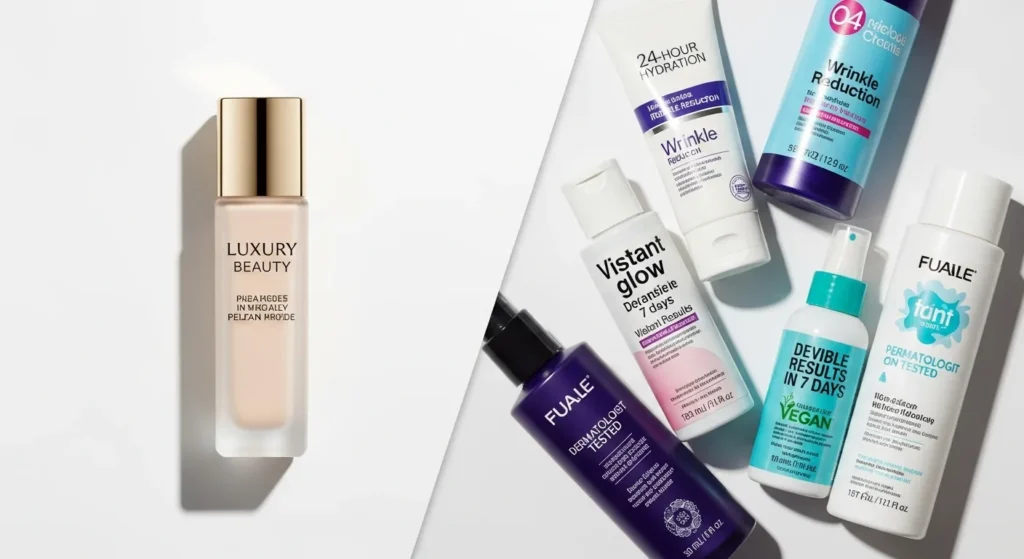
When a Product Promises Less, We Believe It More
Walk down any beauty aisle and you’ll notice a pattern.
The cheaper the product,
the louder the claims.
“Instant results.”
“Clinically proven.”
“Visible change in 7 days.”
“Dermatologist approved.”
Then you reach luxury beauty.
And suddenly—silence.
A single line.
A vague promise.
Sometimes just a feeling.
Strangely, that restraint feels reassuring.
Luxury beauty uses fewer claims not because it has less to offer—but because too many promises weaken authority. In high-end beauty, confidence isn’t proven through words.
It’s communicated through restraint.
More Claims Signal More Insecurity
In consumer psychology, claims function as reassurance.
They exist to overcome doubt.
Mass beauty competes in crowded spaces where trust hasn’t been earned yet. Claims become necessary weapons.
Luxury beauty operates differently.
It assumes trust before the conversation starts.
And when trust is assumed, excessive claims feel unnecessary—even suspicious.
The moment a luxury product starts listing everything it does, it risks sounding like it needs permission.
Authority never asks for permission.
Why Fewer Claims Feel More Trustworthy
Human brains are excellent at spotting exaggeration.
When a product promises too much, too quickly, skepticism rises.
Luxury beauty avoids this trap by doing the opposite:
- Fewer claims
- Broader language
- Slower timelines
- Softer promises
This creates a powerful emotional response:
If they aren’t trying to convince me, they must be confident.
Confidence builds trust faster than proof.
Luxury Beauty Sells Assurance, Not Urgency
Mass beauty thrives on urgency:
- “Fix this now”
- “See results fast”
- “Don’t miss out”
Luxury beauty thrives on assurance:
- “This belongs in your life”
- “Take your time”
- “This will still matter tomorrow”
Brands like Chanel, Dior, and La Mer rarely overwhelm consumers with benefit lists.
They focus on presence, not pressure.
Why Fewer Claims Increase Perceived Quality
Here’s a counterintuitive truth:
The more specific a promise, the more fragile it becomes.
Luxury beauty avoids narrow claims because they limit perception.
A product that promises “reduces fine lines by 23%” invites measurement, comparison, and doubt.
A product that promises “radiance” invites experience.
Luxury brands choose language that:
- Feels timeless
- Allows personal interpretation
- Avoids hard deadlines
This flexibility keeps the product relevant long after trends change.
Experience Replaces Explanation—and Claims
Luxury beauty doesn’t argue for its effectiveness.
It lets you feel it.
The texture.
The calm.
The ritual.
Once experience confirms quality, claims become irrelevant.
This is why luxury products often feel more satisfying even before visible results appear.
The brain trusts direct sensation more than written promises.
Comparison Table: Claim-Heavy vs Claim-Light Beauty
| Feature | Luxury Beauty | Mass Beauty |
|---|---|---|
| Number of Claims | Few, broad | Many, specific |
| Language Style | Suggestive | Persuasive |
| Trust Strategy | Authority | Proof |
| Emotional Effect | Calm, confidence | Urgency |
| Buyer Role | Participant | Evaluator |
Luxury beauty doesn’t want you to audit it.
It wants you to live with it.
Why Too Many Claims Create Pressure
Every claim creates an expectation.
Too many expectations turn beauty into:
- A performance
- A test
- A potential disappointment
Luxury beauty avoids this emotional pressure.
By promising less, it gives users space to:
- Discover
- Adapt
- Appreciate gradual change
This leads to higher satisfaction—even when results are subtle.
Real-Life Example: Two Serums, Two Reactions
Imagine two serums.
One promises:
- Brightening in 5 days
- Firming in 10 days
- Wrinkle reduction in 14 days
The other promises:
- Skin comfort and balance
If the first doesn’t deliver perfectly, disappointment follows.
If the second improves how skin feels day by day, satisfaction grows.
Luxury beauty understands this emotional math.
The Hidden Role of Regulation and Responsibility
Luxury brands also understand the risk of over-claiming.
Specific claims require:
- Clinical substantiation
- Regulatory scrutiny
- Constant updating
By using fewer, broader claims, luxury beauty:
- Avoids exaggerated promises
- Maintains credibility
- Protects long-term trust
This restraint aligns with both psychology and responsibility.
Common Mistakes People Make About Fewer Claims
1. “They’re Not Saying Enough”
They’re saying what matters—and nothing more.
2. “It Must Be Less Effective”
Effectiveness isn’t reduced by silence. Over-promising doesn’t improve results.
3. “I Need Proof for the Price”
Luxury pricing reflects experience, formulation quality, and trust—not just outcomes.
How to Read Luxury Beauty Claims Correctly
Instead of scanning for promises, ask:
- How does this product fit into my life?
- Does it encourage consistency?
- Does it feel calming rather than demanding?
Luxury beauty rewards intuition, not interrogation.
Why This Matters Today
Consumers are overwhelmed by promises.
Every product claims to:
- Fix
- Transform
- Perfect
Luxury beauty offers relief by doing less.
In a noisy world, fewer claims feel honest.
Restraint becomes reassurance.
Key Takeaways
- Luxury beauty uses fewer claims to preserve trust
- Over-promising weakens authority
- Experience replaces persuasion
- Fewer claims reduce pressure and disappointment
- Confidence is communicated through restraint
FAQ
Why do luxury beauty brands make vague claims?
Because broad language allows experience to lead instead of expectations.
Does fewer claims mean less transparency?
No. Information exists—but it isn’t forced as persuasion.
Are luxury products more effective?
Effectiveness depends on consistency, which luxury experience encourages.
Can mass brands use fewer claims?
Only if they’ve earned authority. Silence must be credible.
How should consumers evaluate luxury beauty?
By experience, consistency, and emotional response—not claim quantity.
Conclusion: When You Know Your Worth, You Don’t Over-Promise
Luxury beauty doesn’t need to impress you with words.
It trusts the experience to speak.
By using fewer claims, it protects:
- Authority
- Desire
- Emotional satisfaction
Because in luxury, confidence isn’t loud.
It’s quiet—and that quiet is exactly what makes it powerful.
Disclaimer: This article is for general informational purposes only and reflects branding and consumer psychology insights, not personalized beauty or skincare advice.
Pingback: Why Luxury Beauty Is Sensory — The Hidden Reason It Feels Deeper, Calmer, and More Powerful Than Results Alone
Pingback: Why Luxury Beauty Feels Calming — The Hidden Psychology That Makes It Soothe You Before It Treats Your Skin
Pingback: Why Luxury Beauty Is Designed for Feel — The Emotional Science Behind Why It Feels So Right