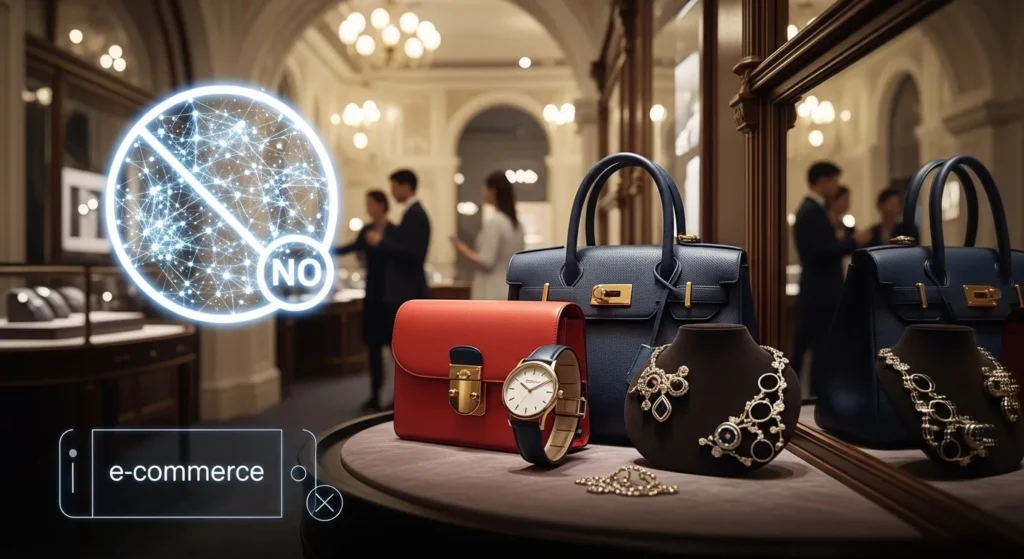
When “Buy Now” Isn’t Always Better
We live in a world where almost everything is one click away.
Groceries. Cars. Homes. Even private jets.
Yet many of the world’s most powerful luxury brands still hesitate—or outright refuse—to sell freely online.
That hesitation isn’t about being outdated.
It’s not about technology fear.
And it’s definitely not about lack of demand.
It’s about what luxury really sells.
Luxury doesn’t compete on convenience.
It competes on meaning.
And the internet, for all its efficiency, quietly threatens the very foundations that luxury depends on.
Luxury Isn’t a Product Category — It’s a Psychological Experience
To understand why luxury avoids online sales, you need to understand one core truth:
Luxury is not bought. It is experienced.
A luxury purchase is rarely impulsive.
It involves:
- Anticipation
- Emotional validation
- Human interaction
- Ritual
Online commerce is built for speed, comparison, and frictionless decisions.
Luxury is built for pause.
That mismatch creates tension.
The Internet Flattens What Luxury Needs to Feel Special
Online shopping does something subtle but powerful.
It places everything on the same plane.
On one screen, a €20 accessory and a €20,000 handbag are:
- Viewed the same way
- Compared with the same tools
- Judged through the same interface
This “digital flattening” is deadly for luxury.
Luxury relies on:
- Atmosphere
- Context
- Ceremony
A white webpage and a “Buy Now” button strip those layers away.
Why Control Matters More Than Convenience
Luxury brands survive by controlling:
- Price
- Perception
- Access
- Environment
Online platforms weaken that control.
Once a product is online:
- It’s screenshotted
- Compared instantly
- Resold easily
- Discounted silently
Luxury brands don’t fear visibility.
They fear loss of authority.
Real-World Examples of Online Resistance
Hermès
Hermès famously limits what can be purchased online.
Its most iconic products:
- Require in-store relationships
- Are not freely available digitally
- Depend on personal interaction
This isn’t elitism.
It’s experience preservation.
Rolex
For decades, Rolex avoided direct online sales.
Why?
- High counterfeit risk
- Price instability
- Grey-market abuse
Even today, digital access is tightly controlled through authorized dealers.
Chanel
Chanel resisted e-commerce far longer than competitors.
The brand believed:
- Digital convenience diluted emotional value
- In-store storytelling mattered more than clicks
Only carefully selected categories later moved online.
The Counterfeit Problem No One Likes to Talk About
Luxury counterfeiting thrives online.
Even with safeguards, digital marketplaces struggle to:
- Verify authenticity
- Control resellers
- Prevent price erosion
For luxury brands, counterfeits aren’t just lost sales.
They are trust poison.
Once customers doubt authenticity, the brand loses its most valuable asset: belief.
Why Pricing Power Collapses Online
Luxury pricing works because it feels justified.
Online environments encourage:
- Side-by-side comparisons
- Discount expectations
- Price alerts
- Deal hunting behavior
Once customers see luxury through a “deal lens,” prestige collapses.
Luxury brands know:
The fastest way to kill desire is to teach people to wait for discounts.
Boutique Sales vs Online Sales: A Clear Contrast
| Factor | Luxury Boutiques | Online Sales |
|---|---|---|
| Experience | Immersive, human | Transactional |
| Price Control | High | Fragile |
| Brand Storytelling | Deep, guided | Minimal |
| Counterfeit Risk | Low | High |
| Emotional Impact | Strong | Limited |
Luxury doesn’t avoid online because it’s ineffective.
It avoids online because it’s too effective at the wrong things.
The Human Element Luxury Refuses to Lose
In luxury, sales staff are not cashiers.
They are:
- Brand ambassadors
- Storytellers
- Relationship builders
A luxury advisor remembers:
- Preferences
- Milestones
- Purchase history
That relationship creates loyalty that no algorithm can replace.
Online sales turn relationships into transactions.
Luxury brands protect relationships fiercely.
Why This Matters Today (More Than Ever)
Digital noise is everywhere.
Endless ads. Endless scrolling. Endless sameness.
In this environment, restraint has become powerful.
Luxury brands that avoid over-digitization:
- Signal confidence
- Preserve mystique
- Stand apart
Silence, scarcity, and selectivity now feel refreshing.
Common Mistakes Brands Make When Going Online
Many brands try to “act luxury” online—and fail.
Key mistakes include:
- Launching e-commerce too fast
- Overexposing products
- Allowing discount culture
- Ignoring experience design
- Losing distribution control
Luxury online requires more discipline, not less.
Hidden Tip: Luxury Isn’t Anti-Digital — It’s Selectively Digital
Here’s the nuance most people miss.
Luxury brands don’t reject the internet.
They use it differently.
They prioritize:
- Storytelling over selling
- Education over conversion
- Presence over pressure
Digital becomes a gateway, not the destination.
Actionable Lessons for Brands and Entrepreneurs
You don’t need to be a luxury brand to learn from this.
You can:
- Control where your products appear
- Protect pricing consistency
- Design buying rituals
- Slow down access intentionally
- Build human touchpoints
Perceived value often rises when availability falls.
Key Takeaways
- Luxury avoids online sales to protect experience, trust, and pricing power
- Digital convenience can dilute emotional value
- Counterfeiting and discount culture are major risks
- Human interaction is central to luxury loyalty
- Selective digital use preserves prestige
Frequently Asked Questions (FAQ)
1. Are luxury brands completely avoiding online sales?
No. Most use digital selectively, not universally.
2. Will luxury ever go fully online?
Unlikely. Controlled access is core to luxury identity.
3. Is online luxury bad for customers?
Not bad—but different. It often removes emotional depth.
4. Why do some luxury brands sell online successfully?
They tightly control categories, pricing, and experience.
5. Does avoiding online sales limit growth?
Short-term volume, yes. Long-term brand value, no.
Conclusion: Luxury Sells Meaning, Not Speed
The internet excels at efficiency.
Luxury excels at intention.
That’s why tension exists—and always will.
Luxury brands avoid online sales not because they fear change, but because they understand something deeper:
When everything is easy to buy, nothing feels special.
And luxury lives in that feeling.
Disclaimer: This article is for general educational and informational purposes and reflects branding and business perspectives, not commercial or financial advice.