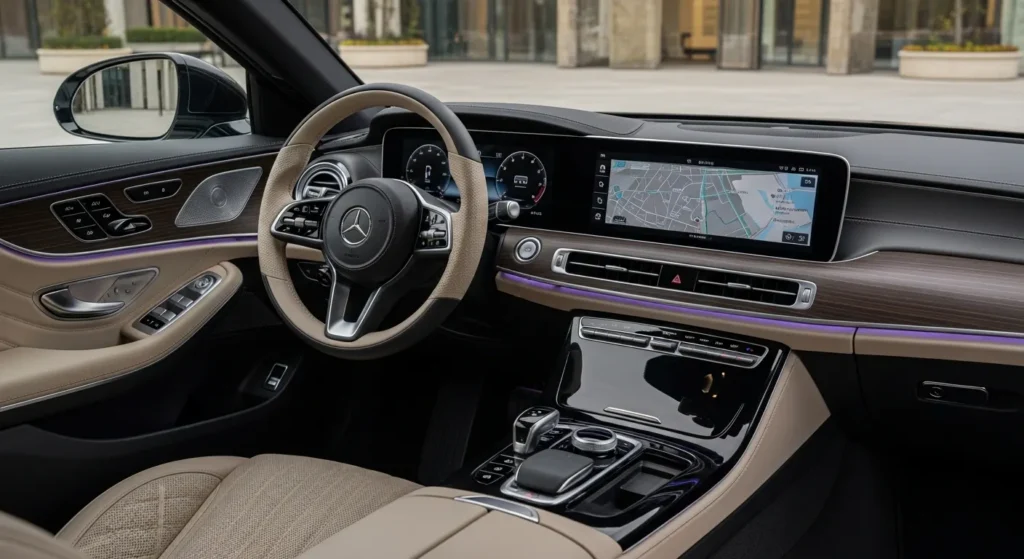
The Feeling You Notice Before You Can Explain It
You don’t have to think about it.
The steering turns smoothly.
The car responds without effort.
Traffic feels less irritating than usual.
You’re not driving harder.
You’re driving lighter.
This is the defining trait of luxury cars: effortlessness.
Not speed.
Not status.
Effortlessness—the sense that the car is doing more of the work for you.
And once you experience it, ordinary driving starts to feel strangely demanding.
Effortless Doesn’t Mean Simple — It Means Sophisticated
Many people assume luxury cars feel effortless because they’re “overpowered” or “soft.”
That’s not true.
Effortless driving is the result of extreme complexity hidden behind simplicity.
Luxury cars focus on:
- Reducing physical strain
- Reducing mental decisions
- Reducing constant correction
The goal isn’t to impress you.
The goal is to disappear beneath you.
When a car feels effortless, it’s because thousands of design choices are quietly working in your favor.
Why the Human Brain Craves Effortlessness
The human brain is constantly managing inputs:
- Noise
- Vibration
- Visual movement
- Muscle tension
- Decision-making
Every correction—steering, braking, posture—adds to cognitive load.
Luxury cars are engineered to reduce that load.
Neuroscience research consistently shows:
- Predictability reduces stress
- Smooth motion lowers fatigue
- Reduced sensory input improves focus
Effortlessness isn’t indulgence.
It’s neurological efficiency.
The Hidden Work Done by Steering Systems
In many cars, steering demands attention.
You’re constantly:
- Correcting lane position
- Fighting road camber
- Adjusting grip pressure
Luxury steering systems are tuned differently.
Brands like Mercedes-Benz and BMW invest heavily in steering calibration that:
- Self-centers naturally
- Filters unnecessary road vibration
- Maintains stability without stiffness
The result?
You steer less—even though you’re driving the same distance.
Your arms relax.
Your shoulders drop.
That’s effortlessness in motion.
Suspension That Thinks Ahead So You Don’t Have To
Luxury suspension doesn’t just react to bumps.
It anticipates them.
Modern premium vehicles use:
- Adaptive dampers
- Continuous road-surface monitoring
- Real-time ride adjustment
Instead of your body absorbing the road, the car absorbs it first.
This matters because unpredictable movement forces your muscles to brace.
Remove that unpredictability, and your body stops working overtime.
Effortlessness isn’t softness.
It’s control delivered early.
Comparison: Effortless Luxury vs Regular Driving
| Driving Factor | Standard Car | Luxury Car |
|---|---|---|
| Steering Corrections | Frequent | Minimal |
| Ride Predictability | Inconsistent | Highly stable |
| Cabin Noise | Constant background strain | Heavily filtered |
| Driver Fatigue | Builds quickly | Reduced significantly |
| Mental Load | High | Low |
Effortlessness is measurable—even if it feels emotional.
Seating: Where Effort Reduction Truly Begins
Seats are not comfort features.
They are load-bearing systems.
Luxury seats are engineered to:
- Distribute pressure evenly
- Support micro-movements
- Adjust posture continuously
- Reduce muscle engagement
Brands like Volvo are known for designing seats that minimize long-term fatigue—not just short-term comfort.
When your seat supports you properly:
- Your legs stop shifting
- Your back stops compensating
- Your neck relaxes naturally
That’s effort removed before you notice it.
Silence Removes More Effort Than Speed Ever Could
Noise forces the brain to stay alert.
Luxury cabins focus on eliminating:
- High-frequency tire noise
- Random vibration
- Wind turbulence at sensitive frequencies
What remains is controlled, low-level sound—something the nervous system finds neutral.
Manufacturers like Lexus are famous for obsessing over secondary noise—sounds most people only notice once everything else is gone.
Less noise means:
- Fewer stress responses
- Less irritation
- Easier concentration
Silence doesn’t feel dramatic.
It feels effortless.
Effortless Driving Is About Fewer Decisions
Luxury cars quietly eliminate micro-decisions.
Examples:
- Seats that adjust automatically
- Climate systems that don’t demand input
- Smooth transmissions that don’t surprise
- Controls placed where your hand expects them
Each removed decision saves mental energy.
Over time, that adds up to:
- Less fatigue
- Better mood
- More patience in traffic
Effortlessness is cognitive kindness.
Real-Life Example: Why Traffic Feels Less Draining
Drivers switching to luxury cars often report:
- Feeling less angry in traffic
- Arriving less tired
- Needing less recovery time after driving
The traffic didn’t change.
The effort required to endure it did.
Luxury cars don’t fix roads.
They fix how your body experiences them.
Common Mistakes People Make About Effortless Cars
❌ Confusing effortlessness with laziness
❌ Thinking soft suspension equals comfort
❌ Focusing only on acceleration numbers
❌ Ignoring fatigue after test drives
Effortlessness reveals itself after the drive, not during the first minute.
Hidden Tip: Notice What You’re Not Doing
To evaluate effortlessness:
- Drive in stop-and-go traffic
- Turn off music
- Observe how often you adjust your posture
- Notice steering corrections
- Pay attention to your jaw and shoulders
If you’re not tensing, the car is working for you.
Why This Matters Today
Modern life is mentally exhausting.
Cars have become:
- Mobile offices
- Transition spaces
- Recovery zones between responsibilities
Effortless cars respect that reality.
They don’t demand energy.
They preserve it.
In a world that constantly asks more from you, effortlessness has become a luxury necessity—not a bonus.
Actionable Steps: How to Choose an Effortless Car
When test-driving:
- Drive slowly as well as fast
- Sit in traffic if possible
- Turn off screens and music
- Pay attention to fatigue, not excitement
- Ask yourself how you feel after the drive
Your body always knows first.
Key Takeaways
- Luxury cars feel effortless because they remove physical and mental load
- Steering, suspension, and seating do invisible work
- Silence reduces stress more than performance
- Fewer decisions create calmer driving
- Effortlessness compounds over time
Frequently Asked Questions
1. Does effortless driving mean luxury cars are boring?
No. They can be exciting when needed—but calm by default.
2. Is effortlessness measurable or subjective?
Both. Engineers measure vibration and noise, while drivers feel fatigue reduction.
3. Can non-luxury cars feel effortless?
Partially, but consistency across conditions is harder to achieve.
4. Do electric cars automatically feel effortless?
They help, but tuning and interior design still matter greatly.
5. Why don’t all cars prioritize effortlessness?
Cost, weight, and engineering complexity limit mass adoption.
Conclusion
Luxury cars don’t feel effortless by accident.
They feel effortless because someone designed them to carry the burden for you.
Less strain.
Less correction.
Less noise.
Less thinking.
Effortlessness isn’t about going faster.
It’s about arriving with more energy than you left with.
Disclaimer: This article is for general informational purposes and reflects industry design principles rather than specific vehicle recommendations.
Pingback: Why Luxury Cars Focus on Comfort — The Real Reason Premium Driving Feels Effortless
Pingback: Why Luxury Cars Feel Calm — The Hidden Engineering That Makes You Feel Instantly at Ease
Pingback: Why Silence Defines Luxury Cars — The Most Expensive Feature You Never See
Pingback: Why Luxury Cars Emphasize Comfort Over Speed — The Real Definition of Premium Driving
Pingback: Why Luxury Cars Feel Heavy — The Engineering Choice That Signals Power, Safety, and Control
Pingback: Why Luxury Cars Prioritize Smoothness — The Hidden Engineering That Makes Them Feel Effortless
Pingback: Why Luxury Cars Are Tuned Differently — The Quiet Engineering That Makes Them Feel Effortless