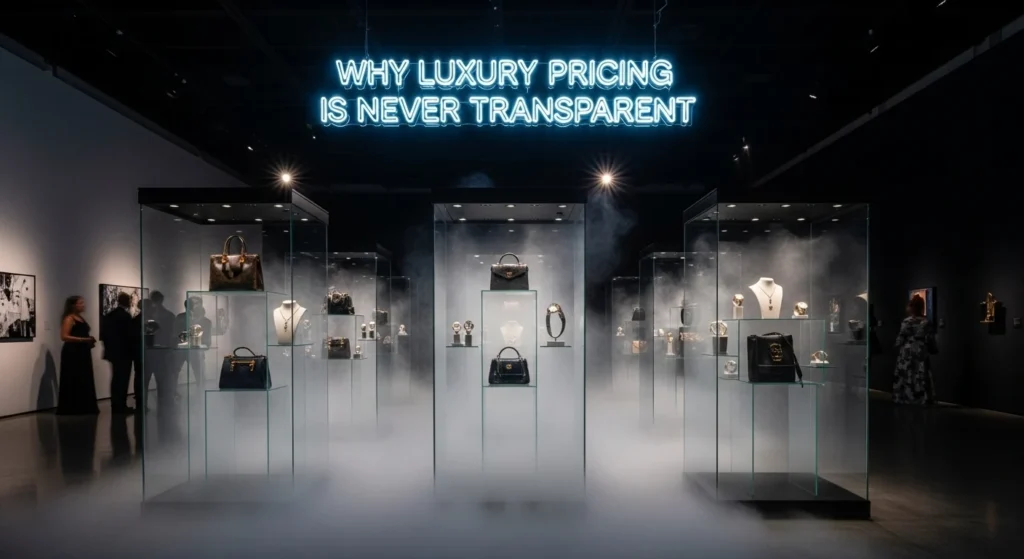
The Price You’re Not Meant to Understand
You ask for the price.
The answer isn’t on a tag.
It’s not on the website.
Sometimes, it’s not even spoken clearly.
In most industries, that would feel suspicious.
In luxury, it feels expected.
Luxury pricing is rarely transparent—not because brands are hiding something, but because clarity would destroy the emotion that makes luxury work.
Luxury doesn’t want you to calculate.
It wants you to feel.
Why Transparent Pricing Works Everywhere—Except Luxury
Transparent pricing is built for rational decisions.
It helps consumers:
- Compare alternatives
- Evaluate value
- Optimize spending
That’s perfect for functional products.
Luxury isn’t functional.
Luxury lives in emotion, identity, and perception.
Once you make luxury pricing fully explainable, it becomes:
- Comparable
- Debatable
- Defensible
And the moment luxury invites debate, it loses authority.
The Core Truth: Luxury Pricing Is a Signal, Not a Calculation
In luxury, price is not a summary of costs.
It’s a signal.
It signals:
- Confidence
- Positioning
- Cultural rank
- Long-term stability
Explaining the price too clearly weakens that signal.
Luxury pricing works precisely because it doesn’t ask for permission.
It states value instead of justifying it.
The Psychology: Why Mystery Increases Perceived Value
Human brains assign more value to things that feel complex or hard to decode.
When pricing is opaque, people subconsciously assume:
- There’s knowledge they don’t yet have
- There’s craftsmanship they don’t fully see
- There’s status embedded beyond materials
This is known in behavioral economics as effort justification—the harder something is to understand or access, the more valuable it feels.
Luxury pricing leans into this instinct deliberately.
Why Cost Breakdowns Would Damage Luxury Brands
Many people ask, “Why not just explain the price?”
Here’s why luxury brands won’t:
- Cost transparency invites comparison
- Comparison invites negotiation
- Negotiation invites doubt
Once a buyer starts asking:
“Is this really worth it?”
Luxury has already lost part of its power.
Luxury pricing must feel settled, not argued.
Real-World Examples of Opaque Luxury Pricing
Some of the world’s most iconic luxury brands are famous for pricing opacity:
- Hermès doesn’t publish prices for many high-demand items
- Rolex allows dealer-based pricing variation
- Chanel adjusts prices globally with little explanation
These brands don’t compete on clarity.
They compete on authority.
Why Fixed, Public Prices Can Feel “Cheap” in Luxury
A visible, universal price creates expectations:
- Immediate access
- Equal treatment
- Transactional fairness
Luxury operates differently.
It prefers:
- Contextual pricing
- Relationship-based access
- Controlled disclosure
When pricing feels personalized or situational, it reinforces exclusivity—even if the number is the same.
Opacity keeps the experience elevated.
Opaque Pricing vs Transparent Pricing: A Comparison Table
| Aspect | Transparent Pricing | Luxury Pricing |
|---|---|---|
| Buyer mindset | Rational | Emotional |
| Price logic | Cost-based | Signal-based |
| Comparison | Encouraged | Discouraged |
| Negotiation | Common | Rare |
| Brand authority | Conditional | Absolute |
Luxury pricing avoids transparency to protect perception.
Why Luxury Brands Avoid Online Price Listings
Putting prices online feels efficient—but luxury avoids it strategically.
Online transparency:
- Encourages comparison shopping
- Reduces personal interaction
- Flattens brand experience
Luxury brands want pricing to be:
- Revealed in the right setting
- Accompanied by service
- Contextualized emotionally
Price is part of the experience, not just information.
The Role of Sales Advisors in Pricing Opacity
Luxury pricing is often delivered through people, not labels.
Sales advisors:
- Frame value through storytelling
- Read customer readiness
- Control pacing and disclosure
This human layer allows brands to:
- Protect price integrity
- Build trust before numbers
- Avoid transactional pressure
In luxury, how you hear the price matters almost as much as the price itself.
Why This Matters Today (And Will Continue To)
Modern consumers are surrounded by price comparison tools.
Everything is ranked, reviewed, and reduced to numbers.
Luxury stands apart by refusing to participate.
Opacity creates:
- Relief from constant optimization
- Emotional space for desire
- A sense of timelessness
In a hyper-transparent world, mystery feels premium.
Common Mistakes Brands Make When Chasing Transparency
Many premium brands damage themselves by copying mass-market logic.
They make mistakes like:
- Publishing detailed cost breakdowns
- Competing on “fair pricing” narratives
- Over-explaining value
- Removing human interaction
Transparency builds trust in utilities.
In luxury, it often builds doubt.
Actionable Insights for Aspiring Premium Brands
If you’re building a high-end or aspirational brand, consider this carefully:
- Decide what should remain unexplained
- Use storytelling instead of spreadsheets
- Protect price confidence across channels
- Avoid encouraging direct comparison
- Let consistency—not clarity—build trust
Luxury pricing works when it feels inevitable, not negotiable.
Key Takeaways
- Luxury pricing is intentionally opaque
- Mystery increases perceived value
- Transparency invites comparison and doubt
- Price in luxury is a signal, not a calculation
- Emotional confidence matters more than explanation
Frequently Asked Questions (FAQ)
1. Is opaque pricing deceptive?
No—it’s a positioning choice, not misinformation.
2. Why do consumers accept unclear luxury prices?
Because they’re buying emotion, identity, and trust—not just materials.
3. Do luxury brands ever explain pricing internally?
Yes, but explanations are rarely shared publicly.
4. Can transparent brands still feel premium?
Sometimes—but true luxury usually avoids full transparency.
5. Will luxury pricing ever become fully open?
Unlikely, because opacity is part of its psychological value.
Conclusion: Mystery Is Part of the Price
Luxury pricing isn’t unclear by accident.
It’s unclear by design.
By refusing to explain every number, luxury brands protect desire, authority, and long-term value—things no spreadsheet can justify.
In luxury, the price doesn’t need to make sense.
Disclaimer: This article is for informational and educational purposes only and reflects general observations about luxury pricing and consumer behavior.