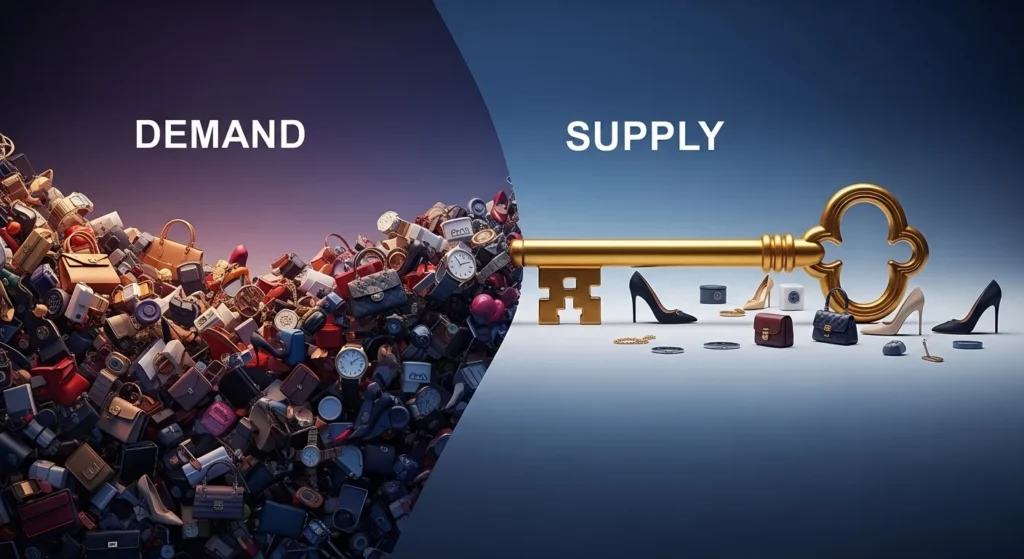
The Counterintuitive Rule Luxury Never Breaks
In most businesses, demand is everything.
More interest?
Produce more.
Scale faster.
Capture the moment.
Luxury does the opposite.
When demand rises, luxury brands pause.
They don’t rush.
They don’t flood the market.
They don’t celebrate volume.
Instead, they protect supply.
That restraint isn’t arrogance.
It’s survival.
Because in luxury, demand is emotional—but supply is structural.
Why Chasing Demand Is Dangerous in Luxury
Demand is loud.
It spikes quickly.
It fades unpredictably.
It’s driven by trends, influencers, and attention cycles.
Luxury cannot afford to follow noise.
If luxury brands chased demand:
- Production would spike
- Quality would slip
- Availability would feel casual
- Desire would turn transactional
Luxury isn’t meant to be responsive.
It’s meant to be consistent.
By controlling supply, luxury stays anchored—even when demand becomes chaotic.
The Psychology Behind Supply Control
People don’t desire what’s easy to get.
They desire what feels considered.
Supply control creates:
- Anticipation instead of impulse
- Respect instead of urgency
- Meaning instead of novelty
When availability is limited, the brain assigns importance.
Not because the product is rare,
but because access feels intentional.
Luxury brands understand this deeply.
They don’t ask, “How many want this?”
They ask, “How many should be allowed to have this?”
Real-World Proof: Luxury Brands That Master Supply Control
Some of the world’s most valuable luxury brands are famous not for demand creation—but for supply discipline.
Clear examples:
- Hermès maintains long waiting lists rather than increasing bag production
- Rolex limits dealer inventory despite overwhelming global demand
- Ferrari deliberately caps annual production to protect brand equity
These companies could sell significantly more.
They choose not to.
Because luxury that prioritizes volume loses its soul.
Supply Control vs Demand Chasing: A Clear Comparison
| Factor | Supply-Controlled Luxury | Demand-Driven Brands |
|---|---|---|
| Brand Position | Confident, composed | Reactive, pressured |
| Customer Emotion | Desire + pride | Urgency + anxiety |
| Pricing Power | Stable, rising | Fragile, discount-prone |
| Long-Term Equity | Compounding | Eroding |
| Brand Trust | Deep | Conditional |
Luxury doesn’t compete for attention.
It creates distance—and lets attention come naturally.
Why This Strategy Works Even When Demand Explodes
Here’s the paradox:
The more luxury restricts supply,
the stronger demand becomes.
But luxury never acknowledges that demand publicly.
Why?
Because acknowledging demand shifts power.
When brands say, “Everyone wants this,”
they validate popularity.
When brands say nothing,
they validate position.
Luxury brands behave as if demand is expected—but irrelevant.
That posture signals authority.
The Hidden Risk of Over-Satisfying Demand
Over-supplying demand feels generous.
In luxury, it’s destructive.
Here’s what happens when supply expands too fast:
- Loyal customers feel diluted
- Ownership loses emotional weight
- Secondary market prices fall
- Discounting becomes necessary
- Brand narrative weakens
Luxury brands rarely collapse overnight.
They soften first.
Then they fade.
Why Supply Control Protects the Customer, Too
This strategy isn’t selfish.
It’s protective.
Controlled supply ensures:
- Higher craftsmanship standards
- Stable resale value
- Long-term satisfaction
- Emotional confidence in ownership
When buyers know not everyone can have what they own,
the experience lasts longer.
Luxury isn’t about instant pleasure.
It’s about enduring reassurance.
Common Mistakes Brands Make When Demand Rises
Even established brands slip under pressure.
Mistakes to avoid:
- Increasing production to “capture momentum”
- Launching too many limited editions
- Expanding distribution too quickly
- Explaining scarcity instead of embodying it
- Letting influencers dictate availability
Luxury brands shouldn’t justify restraint.
Restraint should feel natural.
Actionable Lessons for Brands (Even Outside Luxury)
You don’t need to sell handbags or watches to apply this principle.
How to apply supply control intelligently:
- Limit output intentionally
- Protect quality over speed
- Choose distribution carefully
- Let waiting be normal
- Design growth that feels calm
Supply control isn’t about saying no forever.
It’s about saying yes slowly.
Why This Matters Today
We live in a world of:
- Overexposure
- Endless content
- Constant availability
- Instant gratification
Control has become rare.
And rarity feels premium.
Brands that resist the urge to satisfy every demand signal stability.
In uncertain environments, stability is luxury.
Key Takeaways
- Luxury controls supply to protect meaning
- Demand is emotional; supply is strategic
- Over-availability destroys desire
- True luxury grows through restraint
- Supply control builds long-term trust and equity
Frequently Asked Questions (FAQ)
1. Why don’t luxury brands simply increase prices instead of limiting supply?
Price without supply control feels exploitative. Supply control makes price feel justified.
2. Does supply control frustrate customers?
Not when done correctly. It creates anticipation, not resentment.
3. Can smaller brands use this strategy?
Yes. In fact, restraint is often easier for smaller brands to execute authentically.
4. Isn’t this just artificial scarcity?
True luxury scarcity is structural—based on quality, time, and craft—not gimmicks.
5. What happens if luxury brands stop controlling supply?
They may grow revenue briefly but lose long-term desirability and trust.
Conclusion: Luxury Leads by Restraint
Luxury doesn’t follow demand.
It sets boundaries.
By controlling supply, luxury brands protect:
- Their story
- Their customers
- Their future
In a world obsessed with more,
luxury survives by choosing less—deliberately.
Disclaimer: This article is for general informational purposes and reflects widely observed branding and consumer behavior principles.
Pingback: Why Luxury Brands Limit Availability (And Why That Restraint Makes Them Powerful)
Pingback: Why Luxury Reduces Choice on Purpose — The Hidden Psychology Behind Effortless Decisions