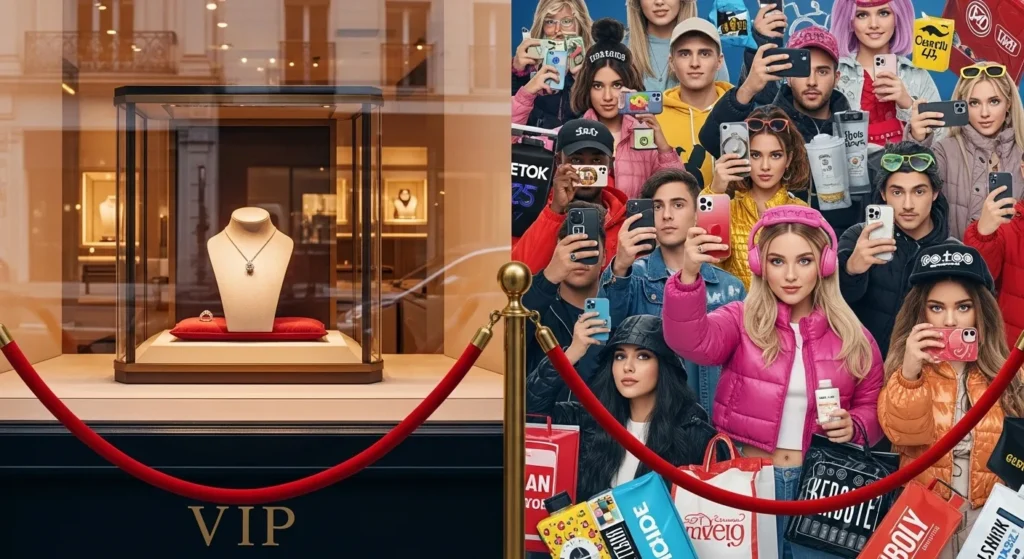
The Silence You Notice—but Don’t Question
Scroll through social media.
Everywhere you look, someone is selling something.
Discount codes.
Affiliate links.
“Must-have” recommendations.
And then—nothing.
Some of the most powerful luxury brands are absent.
No daily posts.
No creator hauls.
No urgency-driven endorsements.
That absence isn’t a missed opportunity.
It’s a strategy.
Luxury brands avoid influencers not because they don’t understand modern marketing—but because they understand human psychology better than most.
Why Influencer Marketing Works Everywhere Else
Influencer marketing thrives on three things:
- Reach
- Relatability
- Repetition
For mass and premium brands, this works perfectly.
Influencers humanize products.
They create familiarity.
They accelerate trust through frequency.
But luxury doesn’t want familiarity.
Luxury wants distance.
The moment a product becomes overly explained, demonstrated, and reviewed—it loses mystery.
And mystery is non-negotiable in luxury.
The Core Conflict: Influence vs Authority
Influencers operate on borrowed credibility.
Luxury brands operate on inherent authority.
That difference matters.
When a luxury brand relies on an influencer:
- Authority shifts outward
- Control weakens
- Messaging becomes negotiable
- Status becomes contextual
Luxury brands don’t want to be recommended.
They want to be recognized.
Recognition feels earned.
Recommendation feels transactional.
Real-World Examples: Brands That Rarely Use Influencers
Some of the world’s most respected luxury brands maintain minimal or highly controlled influencer exposure.
Notable examples:
- Hermès relies on craftsmanship and scarcity, not creator promotion
- Chanel prioritizes brand-controlled storytelling over influencer dependence
- Bottega Veneta famously deleted social media to reclaim brand mystique
These brands understand a key truth:
Visibility does not equal value.
Why Influencers Can Dilute Luxury Perception
Influencers succeed by being accessible.
Luxury succeeds by being selective.
That tension creates risk.
When luxury appears too often:
- It feels common
- It feels explainable
- It feels attainable without effort
Influencer feeds flatten hierarchy.
Luxury relies on hierarchy.
Not social hierarchy—but symbolic distance.
Comparison Table: Influencer Marketing vs Luxury Authority
| Factor | Influencer-Led Brands | Luxury Brands |
|---|---|---|
| Trust Source | Personal relatability | Institutional authority |
| Visibility | High frequency | Selective exposure |
| Messaging Control | Shared | Centralized |
| Emotional Trigger | Familiarity | Aspiration |
| Longevity | Trend-dependent | Time-resistant |
Luxury brands don’t compete for attention.
They let attention come to them.
Why This Matters Today
We live in an era of:
- Influencer fatigue
- Sponsored skepticism
- Content overload
- Algorithmic sameness
Audiences are more aware than ever.
They know when enthusiasm is paid for.
They sense when desire is manufactured.
Luxury brands that stay quiet feel calm in a loud world.
The Hidden Risk: Borrowed Trust Is Fragile
When brands rely on influencers, trust becomes conditional.
If the influencer:
- Loses credibility
- Switches loyalties
- Promotes competitors
- Faces controversy
The brand absorbs collateral damage.
Luxury avoids this by building self-contained trust.
Trust that doesn’t depend on personalities.
Common Mistakes Luxury Brands Make with Influencers
Not all influencer use is wrong.
But missteps are costly.
Mistakes to avoid:
- Overexposure through multiple creators
- Promotional language (“must-buy,” “obsessed”)
- Discount-driven partnerships
- Trend-chasing platforms
- Short-term reach over long-term equity
Luxury brands should never sound excited to sell.
Excitement belongs to the buyer.
What Luxury Uses Instead of Influencers
Luxury doesn’t avoid communication.
It avoids outsourcing meaning.
Instead, luxury relies on:
- Heritage storytelling
- Controlled editorial placements
- Physical experiences
- Cultural association (art, design, craftsmanship)
- Word-of-mouth among insiders
Luxury grows sideways, not outward.
Actionable Lessons for Brands (Even Non-Luxury)
You don’t need to be a luxury house to learn from this.
Apply these principles thoughtfully:
- Choose authority over reach
- Reduce frequency to increase impact
- Protect message consistency
- Avoid over-explaining your value
- Let customers discover—not be convinced
Sometimes, saying less sells more.
Why Silence Builds Desire
Silence creates space.
Space invites imagination.
Imagination fuels aspiration.
Luxury brands understand that:
- Desire grows in absence
- Confidence doesn’t announce itself
- The strongest brands don’t ask to be liked
They wait.
And waiting feels powerful.
Key Takeaways
- Luxury brands avoid influencers to protect authority
- Overexposure weakens exclusivity
- Borrowed trust is fragile
- Silence signals confidence
- Desire thrives on mystery, not repetition
Frequently Asked Questions (FAQ)
1. Do luxury brands never work with influencers?
Some do, but very selectively—often through long-term cultural alignment, not promotion.
2. Isn’t influencer marketing unavoidable today?
Not for luxury. Luxury prioritizes depth over reach.
3. Can influencer marketing harm brand value?
Yes, when it creates over-familiarity or dependency.
4. Why do some luxury brands still appear on social media?
Presence doesn’t equal promotion. Many control narrative without chasing engagement.
5. What’s the biggest risk of influencer reliance?
Loss of authority and long-term trust.
Conclusion: Luxury Doesn’t Compete for Attention
Luxury doesn’t interrupt your feed.
It waits for you to look for it.
By avoiding influencers, luxury brands protect:
- Their voice
- Their mystery
- Their credibility
- Their longevity
In a world shouting for attention,
silence becomes the loudest signal of all.
Disclaimer: This article is for general informational purposes and reflects widely observed branding and consumer behavior principles.