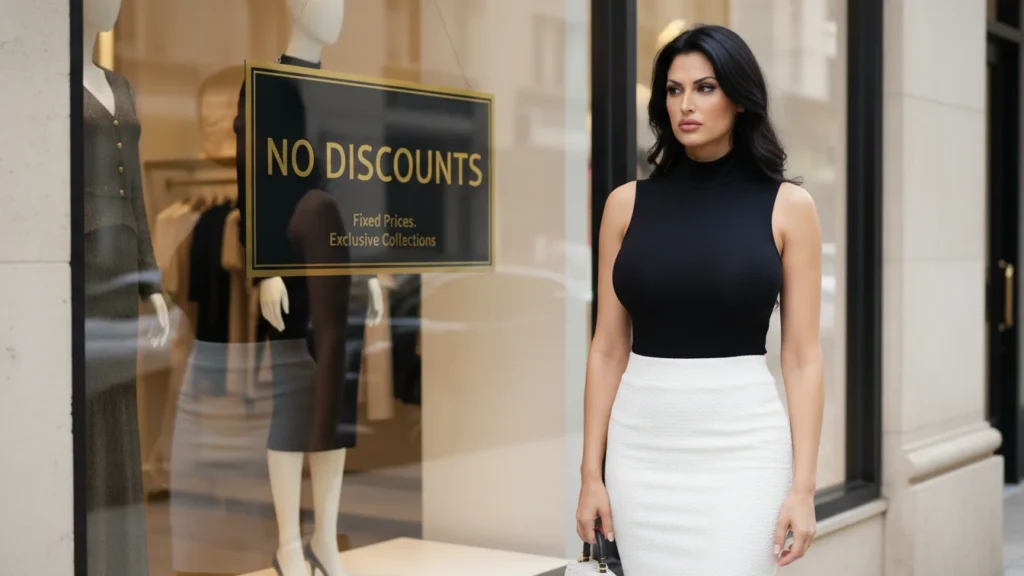
The Price That Never Blinks
You’ve seen the signs everywhere.
“End of Season Sale.”
“Up to 70% Off.”
“Limited-Time Price Drop.”
And then there are luxury brands.
No red stickers.
No clearance racks.
No apology for the price.
While nearly every industry competes on urgency and markdowns, luxury quietly refuses. The price stays exactly where it is—calm, unmoved, almost indifferent.
This isn’t arrogance.
It’s architecture.
Luxury brands don’t avoid discounts because they can’t.
They avoid them because they understand something deeper about human psychology, trust, and value.
Let’s unpack why luxury brands never discount—and why that decision makes them more powerful, not less.
Price Is the Product in Luxury
In mass-market retail, price is flexible.
In luxury, price is part of the identity.
When you buy a luxury product, you’re not just paying for materials or craftsmanship. You’re paying for certainty.
Certainty that:
- The brand knows its worth
- The price will not be undermined tomorrow
- Your purchase will not be publicly devalued
For luxury, price is not a marketing lever.
It’s a signal.
Once that signal wavers, the entire structure weakens.
The Psychology of Non-Discounting: Why Stability Feels Powerful
Human brains are highly sensitive to consistency.
When a luxury brand never discounts, it creates a subtle psychological effect:
- The price feels inevitable
- The decision shifts from “Is it worth it?” to “Am I ready?”
- The brand feels self-assured rather than persuasive
Discounts trigger negotiation behavior.
Luxury triggers commitment behavior.
And commitment is far more durable.
Scarcity Isn’t Manufactured — It’s Maintained
Luxury brands don’t rely on artificial urgency like countdown timers or flash sales.
They rely on structural scarcity:
- Limited production
- Controlled distribution
- Long waitlists
- Predictable availability
Take Hermès.
The Birkin bag doesn’t go on sale—not because it couldn’t, but because scarcity is carefully maintained. The waiting is the filter.
Scarcity without discounts trains customers to wait patiently rather than hunt for deals. Over time, patience becomes part of the culture.
Discounts Create Doubt (Even When They Boost Sales)
Discounts feel good in the moment—but they leave residue.
They introduce questions luxury brands cannot afford:
- Was I overcharged yesterday?
- Will this be cheaper next month?
- Is the full price real—or inflated?
Once customers learn to wait for discounts, full price becomes fictional.
Luxury brands understand that short-term volume gains often destroy long-term trust.
Comparison Table: Luxury vs Discount-Driven Brands
| Factor | Luxury Brands | Discount-Driven Brands |
|---|---|---|
| Pricing Strategy | Fixed, stable, confident | Flexible, reactive |
| Customer Behavior | Commitment-based | Deal-seeking |
| Brand Perception | Timeless, controlled | Promotional, urgent |
| Scarcity | Structural | Artificial |
| Long-Term Value | Preserved | Diluted |
This contrast is not accidental.
It’s deliberate positioning.
Why Wealthy Customers Actually Dislike Discounts
Contrary to popular belief, high-net-worth customers are not obsessed with saving money.
They value:
- Time
- Predictability
- Emotional safety
- Status without explanation
A discount introduces friction.
It forces comparison.
It invites doubt.
For many luxury buyers, paying full price is not a loss—it’s relief.
When Discounting Becomes Brand Erosion
Once a luxury brand discounts, several things happen immediately:
- Loyal customers feel penalized
- Resale value drops
- Exclusivity weakens
- The brand enters comparison mode
This is why brands like Rolex tightly control supply. You don’t negotiate the price of a Rolex. You qualify for the opportunity to buy one.
That distinction matters.
Luxury vs Premium: A Critical Difference Most Brands Miss
Not all expensive brands are luxury brands.
Premium brands:
- Use discounts strategically
- Compete within a category
- Rely on performance narratives
Luxury brands:
- Avoid price competition entirely
- Exist above categories
- Rely on perception stability
Many brands lose their luxury status the moment they chase volume.
What Happens Instead of Discounting?
Luxury brands quietly use alternatives that protect price integrity:
- Limited editions
- Private client previews
- Value-added services
- Exclusive access, not lower prices
Instead of making products cheaper, they make access rarer.
Real-World Example: Louis Vuitton’s Discipline
Louis Vuitton famously destroys unsold inventory rather than discount it.
Controversial? Yes.
Strategic? Absolutely.
The message is clear: the brand would rather absorb losses than dilute meaning.
In luxury, meaning outlives margins.
Common Mistakes Brands Make When Trying to “Act Luxury”
Many brands attempt luxury aesthetics but sabotage themselves by:
- Running frequent sales
- Offering aggressive promo codes
- Training customers to wait
- Overexplaining price
True luxury never explains.
It simply stands.
Actionable Insights for Brands and Consumers
For brands:
- Price integrity is non-negotiable
- Discounts are easy; rebuilding trust is not
- Consistency compounds over decades
For consumers:
- Full price often buys emotional security
- Discounts can signal instability
- Waiting is part of the luxury experience
Why This Matters Today (Without Chasing Trends)
In a world flooded with urgency, luxury offers stillness.
In an economy obsessed with optimization, luxury offers certainty.
And in markets trained to shout, luxury whispers—and is heard.
Key Takeaways
- Luxury brands never discount because price is part of the product
- Discounts introduce doubt, not value
- Scarcity must be maintained, not manufactured
- Consistency builds trust over time
- Luxury competes on meaning, not price
Frequently Asked Questions
1. Do luxury brands ever offer secret discounts?
Rarely. They may offer private benefits, but the price remains intact.
2. Why don’t luxury brands need promotions?
Because demand is built on trust and scarcity, not urgency.
3. Are luxury brands overpriced?
They are priced for perception stability, not cost-plus logic.
4. Why do people wait years for luxury items?
Waiting reinforces desirability and filters commitment.
5. Can a brand regain luxury status after discounting?
It’s possible—but extremely difficult and time-consuming.
Conclusion: The Strength of Standing Still
Luxury brands never discount because they don’t need to convince you.
They know who they are.
They trust time.
They let silence do the work.
And in a world constantly negotiating value, that confidence is the ultimate luxury.
Disclaimer: This article explores branding and consumer psychology concepts for educational purposes and does not provide financial or investment advice.
Pingback: Why Luxury Repairs Take Longer: The Hidden Process Behind Premium Fixes
Pingback: Why Luxury Maintenance Is Expensive: The Hidden System Behind Premium Ownership
Pingback: Why Luxury Brands Destroy Unsold Products — The Strategy Behind a Controversial Choice
Pingback: Why Luxury Stores Feel Empty (And Why That’s Completely Intentional)
Pingback: Why Scarcity Changes Human Behavior (And Why Luxury Depends on It)
Pingback: Why Luxury Brands Fear Overexposure — The Invisible Threat That Can Destroy Desire
Pingback: Why Luxury Brands Sell Fewer Products — The Counterintuitive Strategy That Protects Desire, Power, and Prestige
Pingback: Why Luxury Brands Control Distribution — The Hidden Strategy That Protects Desire, Trust, and Power
Pingback: Why Luxury Needs Scarcity to Survive (Not Just to Feel Exclusive)
Pingback: Why Luxury Brands Control Who Buys — The Hidden Strategy That Protects Desire and Status
Pingback: Why Luxury Brands Avoid Flash Sales — The Quiet Rule That Protects Desire and Power